
The first paid session is not a performance
The first paid coaching session can make a new coach feel as if everything has to be proven at once.
You may feel pressure to create a breakthrough, ask the perfect question, justify the fee, and look more experienced than you feel. That pressure is understandable. It is also the wrong standard.
A clean first paid session is not about performing expertise. It is about helping the client feel oriented enough to begin the work. By the end of the call, the client should know what this coaching container is for, where they are starting, how the work will happen, and what they are taking into the next week.
Delivery is where your marketing becomes real. The person is no longer evaluating your offer from the outside. They are experiencing whether your work feels clear, respectful, and professionally held.
Before you run that first session, it helps to understand the broader [professional coaching boundaries checklist](/professional-coaching-boundaries-checklist/). The first call sits inside that larger container: scope, confidentiality, communication, responsibility, and clean expectations.
The goal is not to make coaching stiff. The goal is to make the session clear enough for useful coaching to happen.
Why new coaches make session one harder
New coaches often confuse being paid with needing to perform.
That can show up in ordinary ways. You jump straight into coaching because pausing to clarify the container feels too basic. You avoid structure because you worry it will make the conversation feel rigid. You build too many forms, dashboards, worksheets, and portals because complexity seems more professional than simplicity.
But the client does not need to be impressed by your backend. The client needs to feel oriented.
They should not have to wonder what the session is for, whether they are supposed to bring an agenda, what happens between calls, how communication works, or what kind of support you do and do not provide.
Client uncertainty should not become the client experience. Professional does not mean complicated. It means clear, consistent, and respectful.
Give the first session a clear job
The first session can include real coaching. It should. But it also has a setup job.
By the end of the session, the client should understand:
- what this coaching container is for;
- where they are starting;
- what they are responsible for;
- how communication and between-session work will happen;
- what first action they are taking before the next session.
This is not administrative filler. It is part of the work.
Structure is not the opposite of depth. Structure gives both coach and client a way to enter the work without confusion. It also gives you something to return to later, especially when the client wonders whether progress is happening.
If you never name the starting point, progress becomes harder to discuss. If you never define what the client is practicing between sessions, the work can stay interesting but vague.
Send a simple welcome before the call
Delivery begins before the session.
You do not need a large onboarding system for your first client. You do need a simple, warm, clear start. Send one short welcome note with the essentials:
- the confirmed date, time, time zone, session length, and meeting link;
- the coaching agreement or terms;
- payment confirmation if relevant;
- communication expectations;
- cancellation or rescheduling expectations;
- a short reflection form.
If you use an agreement, cancellation policy, confidentiality language, or data-handling terms, get proper professional guidance where needed. This article is not legal advice. The practical point is simpler: do not leave important expectations unclear.
Here is a welcome note you can adapt:
Welcome. I am glad we will be working together. Before our first session, please review the agreement, confirm the schedule, and answer the short reflection questions below. In our first session, we will clarify your goal, define where we are starting, and agree on how we will work together.
That is enough. It tells the client what is happening without turning onboarding into a performance of professionalism.
For the reflection form, keep the questions useful and light:
- What made you decide to start now?
- What would make this coaching worth your time and attention?
- What do you want to be different by the end of this coaching container?
- What have you already tried?
- What tends to get in the way?
- How do you prefer to be supported when you feel challenged?
- What should I know about your communication style?
Do not make the client complete a giant intake form unless the answers will actually shape the work. Collecting more information is not automatically more professional. Sometimes it is just more work for the client.
Open the session by orienting the client
Open warmly, then name the shape of the session.
You do not need to sound formal. You do need to be clear. A short opening can settle the call and reduce the pressure to prove value immediately.
Try this:
Before we start coaching on the topic itself, I want us to make sure the container is clear. Today we will reconnect to why you started, name the goal for this work, define where things are starting, and choose one practical next step.
Then confirm the basics:
- the time available for the session;
- the purpose of the first session;
- the agenda for the call;
- the coaching scope;
- confidentiality boundaries;
- whether the client agrees to the plan.
This should not feel like reading terms and conditions aloud. Keep it conversational:
We have 60 minutes today. I want to use the first part to clarify the bigger goal and the starting point, then we can coach around what feels most important today. At the end, we will choose one action before next time. Does that feel like the right use of today?
That last question matters. The client is not being moved through your process. They are participating in it.
Name the goal and baseline before chasing insight
A baseline is a shared starting point. It is not a judgment of the client.
Without a baseline, you may still have useful conversations, but later progress can become hard to discuss. The client may feel clearer or more capable, yet neither of you can describe what changed with any precision.
Use a simple baseline structure:
- current situation;
- desired outcome;
- success signals;
- obstacles;
- client responsibility.
The questions underneath that structure are straightforward:
- What is happening now?
- What do you want to be different by the end of this container?
- What would tell us the work is becoming useful?
- What tends to get in the way?
- What part of this will be your responsibility between sessions?
For a leadership client, the baseline might look like this:
Current situation: “I just became manager of former peers, and my feedback conversations are too soft.”
Desired outcome: “I want to communicate expectations clearly without becoming harsh.”
Success signals: The client prepares feedback before conversations, says the issue directly, follows up, and avoids over-apologizing.
Obstacles: Fear of damaging relationships, lack of practice, and unclear role boundaries.
Client responsibility: Bring real situations, practice between sessions, and reflect honestly on what happened.
For a career client, the baseline might look like this:
Current situation: “I am applying to roles but not getting interviews.”
Desired outcome: “I want clearer positioning and more focused applications.”
Success signals: Sharper target roles, a revised story, better outreach, and more confidence explaining the transition.
Obstacles: Vague direction, discouragement, and applying reactively.
Client responsibility: Do the writing, outreach, and reflection between sessions.
Notice the boundary. This does not promise that the leadership client will become a perfect manager in a few sessions. It does not promise that the career client will get interviews or offers. It gives the coaching work a clear focus and gives the client concrete behavior to observe.
That distinction protects trust.
Use a simple first-session flow
A flow is not a script. It is a rhythm you can return to when the session gets full, emotional, scattered, or too broad.
For a first paid session, use this:
- Reconnect to why the client started.
- Clarify the goal for the coaching container.
- Define the baseline.
- Ask what matters most today.
- Coach around the real challenge.
- Name the insight or shift.
- Choose one action.
- Agree on support or accountability before next time.
The coaching portion may be five minutes or thirty minutes, depending on how much setup is needed. Session one is not weaker because you spent time clarifying the work. It is often stronger because of it.
There is a tradeoff here. Too much structure can make the session feel like an intake interview. Too little structure can make the client feel responsible for holding the process. Aim for a clear opening, a shared baseline, and enough room for the real conversation to breathe.
If the client becomes emotional, slow down. You do not need to force the agenda. If they bring something outside your coaching scope, stay within your role and refer to an appropriate licensed or qualified professional when needed. Coaching can support reflection, action, communication, habits, leadership, career clarity, and decision-making. It should not be positioned as therapy, medical care, legal advice, or financial advice.
End with one clear between-session action
The client should leave knowing what they are practicing, observing, deciding, or doing.
Vague homework creates vague continuity. It also makes the next session harder, because there is no clear thread to pick up.
Instead of:
Be more confident this week.
Use:
Before your next one-on-one, write the expectation in one sentence and say it without apologizing.
Instead of:
Work on your career clarity.
Use:
Review ten job descriptions and highlight the phrases you want your next role to include.
Instead of:
Prioritize yourself.
Use:
Choose one evening this week where work ends at 6:30, and write down what made that easy or difficult.
The better action is specific, realistic, and observable. It should be small enough to do and meaningful enough to bring back into the next session.
Here is a closing script:
What are you taking from today, what action are you committing to, and what might get in the way before we meet again?
You can add:
What support or accountability would be useful between now and then?
That question should match your actual coaching agreement and communication norms. Do not offer unlimited access if that is not part of your container. Do not imply emergency support if you do not provide it. Clear support is kinder than vague availability.
Keep notes that support continuity
You do not need elaborate notes. You do need enough continuity that the client feels remembered and the work can build.
After the session, record:
- the coaching goal;
- the key baseline points;
- the main insight or shift;
- the agreed action;
- the likely obstacle;
- the follow-up point for next session.
That is usually enough.
Do not write a novel. Do not casually store sensitive information the coaching work does not require. Follow the confidentiality and data-handling commitments you made to the client, and get appropriate professional guidance for policies and systems when needed.
Your notes are not surveillance. They are a continuity tool.
The next time you meet, you can open with:
Last time, we named the goal as clearer feedback conversations without over-apologizing. You committed to writing the expectation in one sentence before your one-on-one. What happened when you tried that?
That opening tells the client the work is being held. It also brings the session back to reality instead of starting from scratch.
Watch for these first-session mistakes
Trying to create a dramatic breakthrough to justify the fee can make you overcoach, overtalk, or reach too quickly for insight. A clean first session does not need theater. It needs clarity and momentum.
Starting with “What do you want to talk about?” before the container is clear can also weaken the session. The client can absolutely shape the agenda. But they should not have to carry the structure of the engagement.
Vague homework is another common problem. “Be more confident” may sound encouraging, but it gives the client nothing specific to practice. Choose one action the client can actually do, observe, or reflect on.
Be careful with tools, too. A first client does not require a full portal, a branded resource library, and ten automated workflows. Start with one agreement, one reflection form, one shared goal document, one place for actions, and a simple note-taking system.
The most important boundary is scope. Do not blur coaching with therapy, consulting, legal, medical, or financial advice. Stay honest about your role. If the client needs support outside coaching scope, do not try to absorb that responsibility.
And do not treat the first paid client like proof to be collected. The client is not a future testimonial, case study, or referral source. They are a person who trusted you with meaningful work. Proof, testimonials, and referrals come later only with consent and responsible context.
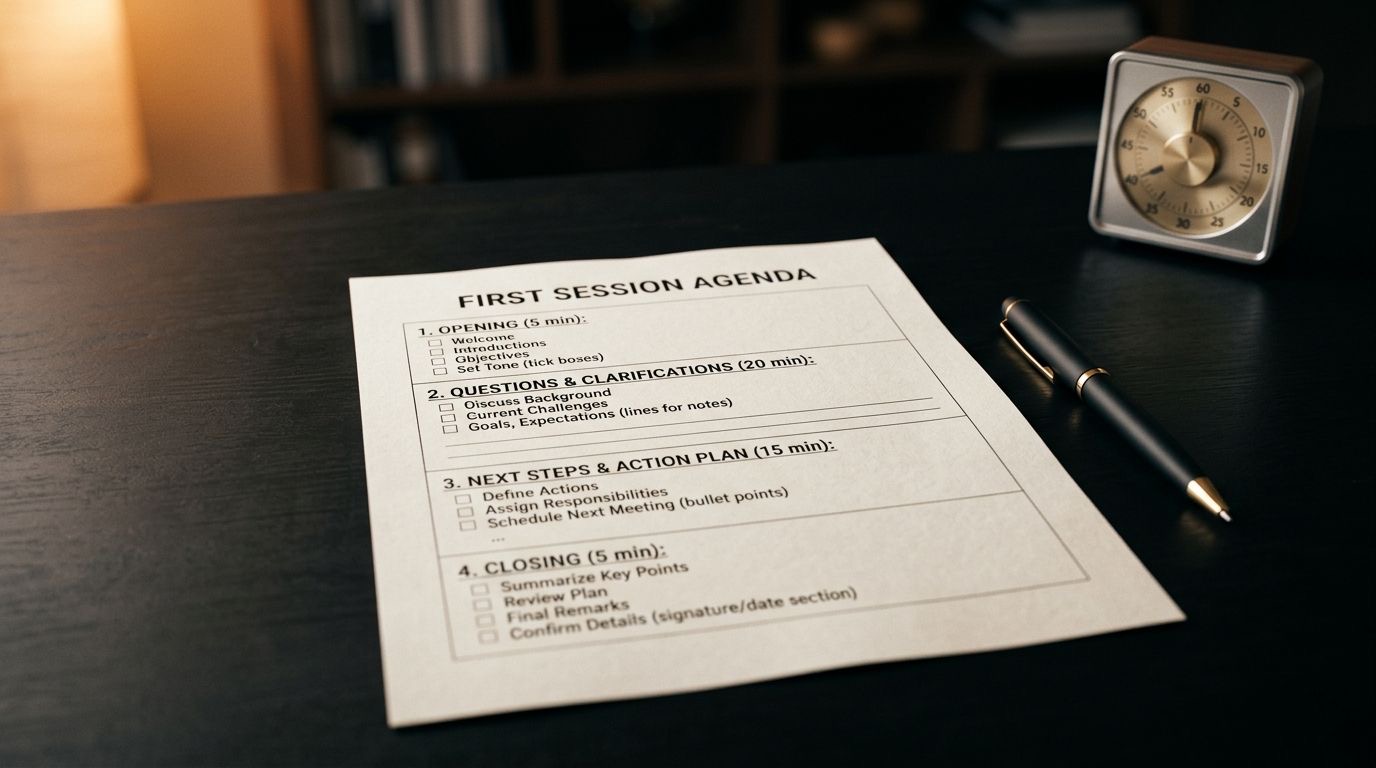
Build your one-page session plan
Before your next first session, draft a one-page plan. Keep it simple.
Use these five sections:
Pre-session
- Send the welcome note.
- Confirm schedule, time zone, length, and meeting link.
- Send agreement or terms.
- Confirm communication and rescheduling expectations.
- Send short reflection questions.
Opening
- Welcome the client.
- Confirm time and agenda.
- Reconnect to why they started.
- Clarify coaching scope and confidentiality boundaries.
- Ask for consent to the session plan.
Baseline
- Name the current situation.
- Clarify the desired outcome.
- Define success signals.
- Identify obstacles.
- Confirm client responsibility.
Coaching focus
- Ask what matters most today.
- Coach around the real challenge.
- Name the insight or shift.
Close
- Choose one between-session action.
- Name what might get in the way.
- Agree on support or accountability.
- Confirm next session.
- Record simple continuity notes.
This is enough to begin professionally. You can refine it as you learn, but do not wait until your system is perfect to deliver with care.
A calm next step
Use the [professional coaching boundaries checklist](/professional-coaching-boundaries-checklist/) before your first paid session, then write your one-page session plan.
Do not try to become impressive. Try to become clear.
A clean first session gives later sessions a better chance of being focused. It helps the client feel oriented. It gives both of you a shared starting point. It does not guarantee results, renewals, referrals, or testimonials.
That is part of why it is trustworthy.


0 comments
No comments yet.