

A useful session can still end too loosely
A client can leave a coaching session feeling seen, relieved, and full of insight, then open their calendar two days later and think, “What exactly was I supposed to do with that?”
That gap matters. Not because every session needs homework, and not because coaching should become a project-management exercise. It matters because the client’s life is where the work gets tested. If the action is vague, the communication norms are unclear, or the coach forgets what was agreed, the client can start to feel as if the session mattered only while both people were on the call.
Follow-through is the part of professional delivery that helps the work continue without requiring the coach to be constantly available.
If you are building your first delivery rhythm, this system belongs inside your [professional coaching boundaries checklist]. Scope, communication, confidentiality, client responsibility, and support expectations should be clear before you ask a client to trust the process between sessions.
The standard is simple: the client should know what they are working on, what happens next, and how support works.
Where follow-through usually breaks
Follow-through often breaks for understandable reasons. A session feels vivid, so the coach assumes they will remember the important pieces. The client has a useful insight, so both people treat the insight as if it were already an action. A coach wants to be generous, so they leave between-session access undefined. Then a client sends a long message, asks for quick help in real time, or brings something that needs more space than email can responsibly hold.
There is also a quieter problem: overbuilding. A new coach may create a portal, a dashboard, a folder of worksheets, automated reminders, and a polished client hub before the basic rhythm is clear. Those tools can be useful later, but they do not fix vague actions or inconsistent communication.
The client does not need to be impressed by your backend. They need to feel oriented. They need to know what was agreed, what they are trying next, where to put questions, and how the next session will pick up the thread.
Use a light structure, not a heavy system
A follow-through system should answer five practical questions:
- What are we working toward?
- What did the client notice, learn, or decide?
- What will the client practice, observe, decide, or do before next time?
- What might get in the way?
- What support or accountability is included?
This is a rhythm, not a script. You still listen. You still adapt. You still make room for what is actually happening in the session.
There is a tradeoff here. Too little structure leaves the client guessing. Too much structure can make coaching feel like compliance work. The useful middle is a small set of repeatable habits: one clear action, one simple note, one place to track actions, one communication norm, one midpoint feedback check, and one closing reflection.
If a client raises something outside the scope of coaching, do not try to solve it through a follow-through message. Slow down, name the boundary, and point them toward the appropriate kind of professional support when needed.
End each session with one clear next action
The client should leave each session knowing what they are practicing, observing, deciding, or doing before the next call.
The action should be specific, realistic, and observable. It does not need to be impressive. A small, well-chosen action often gives the next session better material than a large assignment the client avoids.
For example, “Be more confident this week” sounds encouraging, but it gives the client nothing clear to do. A better action is: “Before your next one-on-one, write the expectation in one sentence and say it without apologizing.”
“Work on your career clarity” is also too broad. A clearer version is: “Review ten job descriptions and highlight the phrases you want your next role to include.”
“Prioritize yourself” may point to a real issue, but it is hard to follow. Try: “Choose one evening this week where work ends at 6:30, and write down what made that easy or difficult.”
Before the session ends, test the action with three questions:
- Can the client say what they will do?
- Can they say when they will do it?
- Can they say what they will notice?
You might close with:
“Before we close, let’s name what you are taking from today, what action you are committing to, and what might get in the way before we meet again.”
If the action is still broad, help the client make it smaller:
“Let’s make that more observable. What is the exact thing you will practice, decide, write, notice, or do before next time?”
This is not about controlling the client. It is about making the work usable after the call ends.
Keep notes that support continuity
Your session note does not need to be long. It needs to help you return responsibly to what mattered.
A simple five-line note is enough for many early coaching engagements:
- Goal or current focus
- Key insight or decision
- Agreed action
- Likely obstacle
- Follow-up point for next session
For example:
| Field | Example |
| — | — |
| Goal or current focus | Communicate expectations more clearly with a direct report |
| Key insight or decision | Client notices they soften the first sentence to avoid tension |
| Agreed action | Draft the first sentence before the next one-on-one |
| Likely obstacle | Fear of damaging the relationship |
| Follow-up point | What happened when they used the prepared sentence? |
The note is for continuity, not surveillance. It helps you remember what the client agreed to, what mattered, and where to return next time.
Keep this bounded. Do not write a novel after every session. Do not casually store sensitive details that are not needed for coaching continuity. Keep notes aligned with the confidentiality and data-handling commitments you have made to the client. This is practical delivery guidance, not legal advice about records or retention.
Put actions in one place
Follow-through gets messy when actions are scattered across email, chat, notebook margins, and memory.
Choose one place for actions. It can be a shared document, a private coach document, a client worksheet, or a table in a tool you already use. The format matters less than whether you use it consistently.
A lean action tracker can look like this:
| Session date | Focus | Action | What to notice | Support needed | Follow-up result |
| — | — | — | — | — | — |
| May 12 | Feedback conversation | Write the first sentence before the one-on-one | Where the message gets softened | Bring draft sentence to next session | Review next call |
For some clients, a shared tracker helps them stay oriented. For others, you may keep the tracker privately and recap the action by email after the session. Choose the format that fits your coaching agreement, your client’s preferences, and your confidentiality commitments.
Do not build a dashboard before the client needs one. A simple table used every session is more professional than a beautiful system nobody updates.
Set communication norms before they are tested
Between-session communication should not be invented in the middle of a stressful message.
Name the norms early. The client should know whether they can message between sessions, which channel to use, what response time to expect, what kind of support is included, what kind of support is not included, and what happens if something needs more than a brief reply.
You can use language like this:
“You can send brief reflections between sessions by email. I will read them before our next session, but I do not provide real-time coaching between calls unless we have agreed to that separately.”
If a client sends something that needs more space, you can respond with:
“This sounds like it needs more attention than a quick message. We can bring it into our next session, or we can decide whether an additional session would be appropriate.”
That kind of response protects both people. The client is not ignored, and the coach is not pretending that unlimited access was included.
Generosity without clarity can create resentment or confusion. Boundaries do not weaken the support. They make the support more trustworthy.
Start the next session by returning to what happened
The next session should not begin as if the previous action disappeared.
Open by returning to reality:
- What changed since last time?
- What happened with the agreed action?
- What did you notice?
- What matters most today?
This helps the client see progress, friction, and patterns. It also shows that the coaching is continuous, not a series of disconnected conversations.
If the client did not complete the action, do not turn that into shame. Treat it as information.
You might say:
“No shame in that. Let’s use it as information. Was the action too large, poorly timed, unclear, or less important than we thought?”
Or:
“Let’s look at what made the action hard to complete. Was the step too large, was the timing unrealistic, or did a different obstacle show up?”
Sometimes an incomplete action reveals more than a completed one. It may show that the client agreed too quickly, the step was too ambitious, the goal has shifted, or a real obstacle needs attention.
Ask for midpoint feedback while there is still time to adjust
Do not wait until the final session to learn that the client felt unclear.
Midpoint feedback helps you adjust the container before the engagement is nearly over. It also gives the client permission to speak about the process, not only the topic they brought to coaching.
Halfway through the engagement, ask:
- What has been most useful so far?
- What should we adjust?
- What feels unclear?
- What progress are you noticing?
- What do you want to focus on for the remaining sessions?
You can introduce it simply:
“We are halfway through this coaching container. Before we keep going, I want to check how the support is landing. What has been useful, what feels unclear, and what should we adjust?”
If the client says they leave with too many ideas, do not defend the process. Adjust the process.
“That is helpful to know. For the remaining sessions, would it help if we ended with one primary action instead of several options?”
If the client is not sure whether they are making progress, return to the baseline:
“Let’s go back to what we named at the beginning. Where do you see movement, and where does it still feel the same?”
Feedback is not a threat to the coaching relationship. Handled well, it is part of the relationship.
Close the container with reflection
The final session should not feel like the calendar simply ran out.
Closing reflection helps the client integrate the work. It gives them a chance to name what changed, what they learned, what remains unfinished, and what support may be useful next.
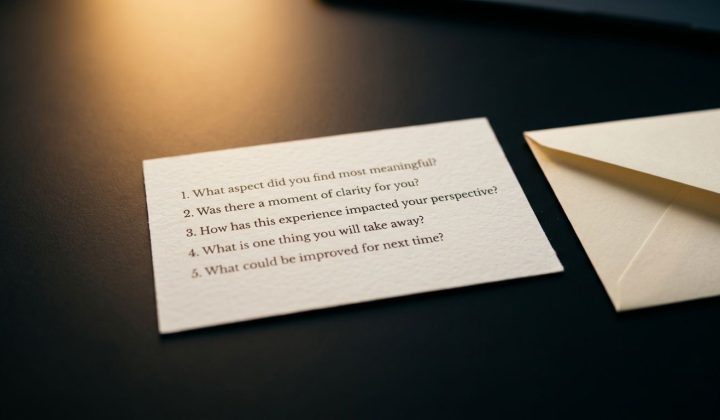
Useful closing questions include:
- When we started, what was the main challenge?
- What is different now in how you think, decide, or act?
- What did you learn about yourself?
- What can you now do that was harder before?
- What remains unfinished?
- What support do you need next?
You can say:
“Before we close this container, I want to help you integrate the work. What is different now in how you think, decide, or act, and what remains unfinished?”
This is not the testimonial ask. A closing reflection may later help you [ask coaching clients for testimonials responsibly], but the purpose here is client integration. Do not turn the final reflection into proof collection before the client has had room to understand their own experience.
The smallest system to start with
You do not need a complex client portal to deliver professionally.
Start with:
- One shared or private goal document
- One action tracker
- One five-line session note
- One communication norm
- One midpoint feedback check
- One closing reflection
That is enough for many early coaching engagements. If you are still shaping the broader delivery process, pair this with a guide on how to [deliver coaching professionally from your first client]. If you are preparing for a first paid engagement, it can also help to review how to [run a professional first coaching session].
The standard is not complexity. The standard is whether the client feels oriented and whether you can responsibly continue the work from one session to the next.
Mistakes that make follow-through feel unclear
The first mistake is ending with “think about what we discussed.” That may sound reflective, but it often leaves the client with no concrete next step.
The second mistake is letting between-session communication become unlimited because you want to be helpful. Support needs shape. Without it, both people may start guessing.
The third mistake is over-recording. Notes should support continuity. They should not become a casual archive of sensitive client material you do not need.
The fourth mistake is building tools before you have a rhythm. A portal can be useful later, but it will not fix vague actions, unclear communication, or missed follow-up.
The fifth mistake is treating incomplete action as failure. Sometimes the missed action is the coaching material.
The sixth mistake is waiting until the end to ask whether the support is working. Midpoint feedback is more useful because you can still adjust.
The seventh mistake is turning follow-through into proof collection too quickly. Deliver well first. Let the client integrate the work before you ask for a testimonial or [ask for coaching referrals respectfully].
Build this before your next session
Choose one current or upcoming client and create the smallest version of this system before the next session.
Write the communication norm. Create the action tracker. Add the five-line note format. Decide when the midpoint feedback check will happen. Prepare the closing reflection questions now, even if the closing session is weeks away.
Then use the system lightly and consistently.
If you have not yet named your scope, confidentiality commitments, communication boundaries, and client responsibilities, start with the [professional coaching boundaries checklist] first. Follow-through only works when the coaching container is clear enough to hold it.

0 comments
No comments yet.