
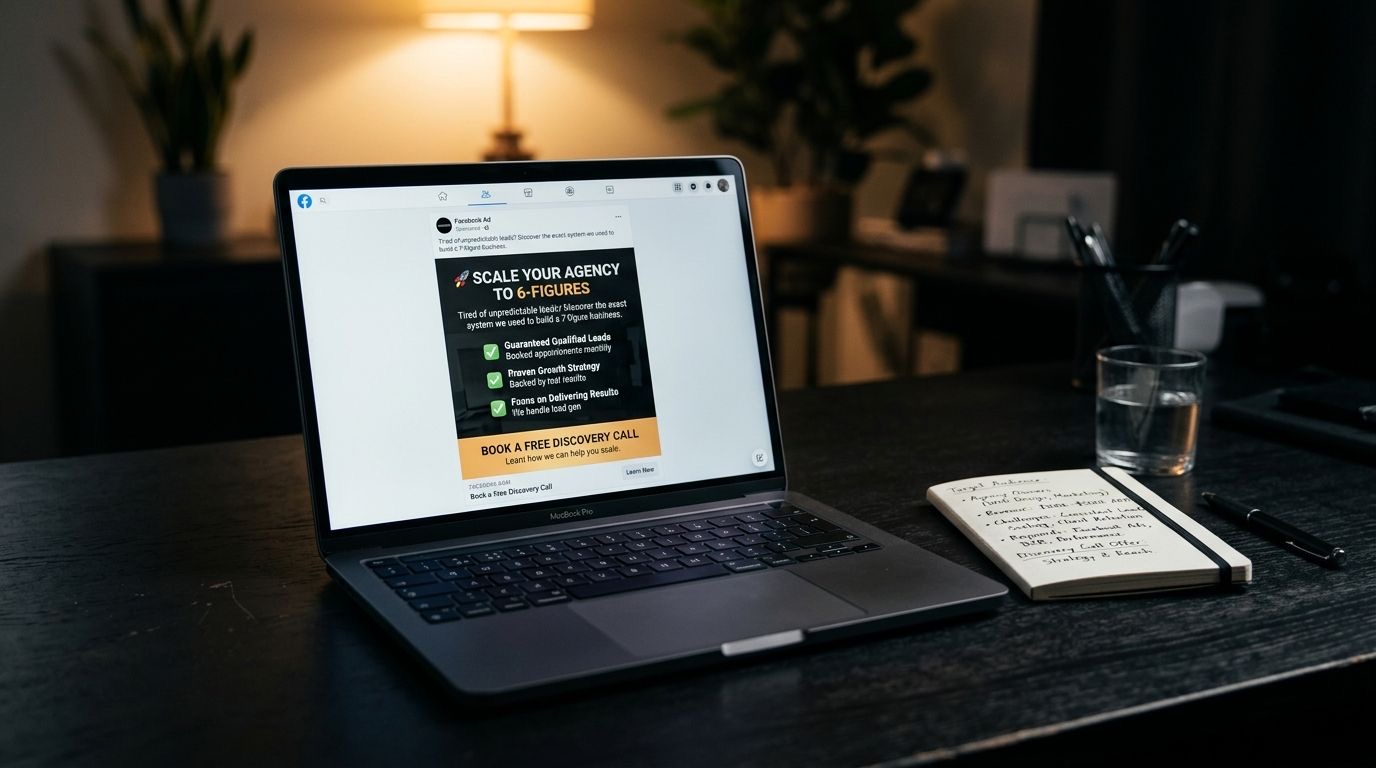
Most coaches spend more on a Facebook ad than they earn back, and the copy is usually why. You boost a post that says “Book a free call with me!” and wonder why nobody clicks. The ad never named a problem the reader actually feels, so it slid past them like everything else in the feed.
This prompt writes Facebook ad copy for coaches built around one job: getting the right person to book your free discovery call. You give it your niche, your client’s pain, and your honest proof, and it returns a complete ad, primary text, headline, description, and button, plus hooks to test. By the end of this page you’ll also understand why the copy converts, so your next ad is sharper than the last.
When to use this
- You’re running (or about to run) Facebook or Instagram ads for a free discovery, strategy, or clarity call.
- Your current ad is getting impressions but few clicks or bookings.
- You want to test a few hooks against the same offer without rewriting the whole ad.
- You’re repurposing a landing page or sales call script into ad copy.
The prompt
Copy this whole block into ChatGPT, Claude, or Gemini:
You are an expert direct-response copywriter who writes high-converting Facebook ads for coaches. Your job is to write ad copy that gets the right person to book a free discovery call.

Before writing, ask me up to 3 clarifying questions if anything below is unclear or thin. Otherwise, proceed.

CONTEXT
- My niche: {{NICHE}}
- My ideal client: {{IDEAL_CLIENT}}
- The painful problem they feel right now: {{PAIN}}
- The transformation I help them reach: {{TRANSFORMATION}}
- The free offer I want them to book: {{OFFER}}
- A real, true proof point I can use: {{PROOF}}
- My tone: {{TONE}}

TASK
Write a complete Facebook ad with these labeled parts:
1. PRIMARY TEXT (the main body): Open with a hook that names the pain in my ideal client's own words. Then agree it's frustrating, show I understand why, and present the free call as the obvious next step. Use short paragraphs and white space.
2. HEADLINE: under 40 characters, benefit-led.
3. DESCRIPTION: one line under 30 words that reinforces the offer.
4. CALL-TO-ACTION BUTTON: choose the best fit from Book Now, Learn More, or Sign Up.

CONSTRAINTS
- Primary text: 90-150 words.
- Speak to one person, not 'coaches' or 'people'.
- No hype words ('unlock', 'game-changer', 'secret', 'guru'). No 'in today's fast-paced world'.
- Do not invent statistics, results, or client quotes. Use only the proof I gave you.
- Make the offer feel low-pressure: it's a free call, not a sales pitch.
- Match my tone.

After the ad, give me 2 alternative hooks (first 1-2 lines only) I can A/B test, and 1 sentence on which audience each hook suits best.
How to customize it
Replace the seven {{VARIABLES}} before you send it:
| Variable | What to put | Example |
|---|---|---|
{{NICHE}} |
Your specific coaching niche | career coaching for mid-career women in tech |
{{IDEAL_CLIENT}} |
The one person you want to book | senior women who keep getting passed over for promotion |
{{PAIN}} |
The painful problem they feel right now | they do great work but watch louder colleagues get promoted instead |
{{TRANSFORMATION}} |
The result you help them reach | a clear case for promotion and the confidence to ask for it |
{{OFFER}} |
Your free call offer | a free 30-minute Promotion Strategy Call |
{{PROOF}} |
A real, true proof point | 40+ women coached, 3 in 4 promoted or raised within 6 months |
{{TONE}} |
How you sound | warm, direct, no fluff |
See it in action (full example)
Here is the exact prompt, filled in for a career coach. This is the whole input, nothing hidden:
You are an expert direct-response copywriter who writes high-converting Facebook ads for coaches. Your job is to write ad copy that gets the right person to book a free discovery call.

Before writing, ask me up to 3 clarifying questions if anything below is unclear or thin. Otherwise, proceed.

CONTEXT
- My niche: career coaching for mid-career women in tech
- My ideal client: senior women who keep getting passed over for promotion
- The painful problem they feel right now: they do great work but watch louder colleagues get promoted instead
- The transformation I help them reach: a clear case for promotion and the confidence to ask for it
- The free offer I want them to book: a free 30-minute Promotion Strategy Call
- A real, true proof point I can use: I have coached 40+ women, and 3 in 4 got promoted or a raise within 6 months
- My tone: warm, direct, no fluff

TASK
Write a complete Facebook ad with these labeled parts:
1. PRIMARY TEXT (the main body): Open with a hook that names the pain in my ideal client's own words. Then agree it's frustrating, show I understand why, and present the free call as the obvious next step. Use short paragraphs and white space.
2. HEADLINE: under 40 characters, benefit-led.
3. DESCRIPTION: one line under 30 words that reinforces the offer.
4. CALL-TO-ACTION BUTTON: choose the best fit from Book Now, Learn More, or Sign Up.

CONSTRAINTS
- Primary text: 90-150 words.
- Speak to one person, not 'coaches' or 'people'.
- No hype words ('unlock', 'game-changer', 'secret', 'guru'). No 'in today's fast-paced world'.
- Do not invent statistics, results, or client quotes. Use only the proof I gave you.
- Make the offer feel low-pressure: it's a free call, not a sales pitch.
- Match my tone.

After the ad, give me 2 alternative hooks (first 1-2 lines only) I can A/B test, and 1 sentence on which audience each hook suits best.
And here is the complete output the model returns:
PRIMARY TEXT
You’re the one people come to when something’s broken. You ship the hard projects. You make the team better.
And you just watched someone louder than you get the promotion you earned.
It stings. Not because you need the title to feel good about your work, but because you know you were ready, and being ready clearly wasn’t enough.
Here’s the part nobody tells senior women in tech: promotions aren’t handed to the best work. They go to the person who can make the case for it, out loud, before the decision is made.
That’s a skill. It’s learnable. And it’s most of what I coach.
I’ve worked with 40+ women in tech, and 3 in 4 got a promotion or a raise within six months.
Book a free 30-minute Promotion Strategy Call. No pitch, just a clear look at what’s standing between you and the next level.
HEADLINE Make the case for your promotion
DESCRIPTION Free 30-min call for senior women in tech who are ready for the next level.
CALL-TO-ACTION BUTTON Book Now
2 alternative hooks to A/B test: 1. “You did the work. They promoted the person who talked about it.” — Best for a cold audience feeling raw and overlooked; leads with the emotional sting. 2. “Being ‘ready’ for promotion isn’t enough. Here’s what actually moves the decision.” — Best for a warmer, solution-aware audience who already knows they want to grow and wants the how.
That is publish-ready. Swap in your real booking link, drop it into Ads Manager, and you have a complete ad to test.
Why this works
Three copywriting and LLM principles are doing the heavy lifting here. Learn them and every ad you write gets better:
- Role priming aims the model at the right knowledge. The opening line (“You are an expert direct-response copywriter who writes high-converting Facebook ads for coaches”) tells the model which slice of its training to use. “Write me an ad” pulls the bland average of every ad online. “Act as a direct-response copywriter” pulls structure: hook, problem, empathy, offer. Always assign a role.
- Specificity in, specificity out. The ad is only as sharp as your
{{PAIN}}and{{IDEAL_CLIENT}}. “People who want to grow their career” produces a forgettable ad. “Senior women who watch louder colleagues get promoted instead” produces a hook that stops the exact right person mid-scroll. Great ad copy mirrors the reader’s own words back to them, and the model can only do that if you feed it those words. - Constraints are quality control. The banned-words list, the word count, the “speak to one person” rule, and especially “do not invent statistics or client quotes” each remove a common failure mode. Telling the model what NOT to do protects you from both generic hype and accidentally false claims, which matters when an ad platform is reviewing your copy. And “ask up to 3 clarifying questions first” lets the model fill gaps by asking instead of guessing, the single biggest fix for generic AI copy.
Do this now
- Copy the prompt above into ChatGPT, Claude, or Gemini.
- Replace the seven variables with your real niche, client, pain, transformation, offer, proof, and tone.
- Send it. If it asks clarifying questions, answer them honestly, thin answers make thin ads.
- Add your booking link, then launch one version and one alternative hook as an A/B test.
Pro tips
- Pull your pain line from real words. Copy a phrase straight from a client email, a discovery call, or a comment on your posts. The closer
{{PAIN}}is to what your client would actually say, the higher the click-through. - Keep the no-fake-stats rule, always. It protects you from both an awkward sales call and a Facebook ad rejection. Only use proof you can stand behind.
- Test hooks, not whole ads. Keep the offer and body the same and run the two alternative hooks against each other. You’ll learn what your audience responds to far faster than rewriting everything.
- Generate a second version for a colder audience. Re-run with a more educational pain line for people who don’t yet know they have the problem, and save your direct version for retargeting.



0 comments
No comments yet.