
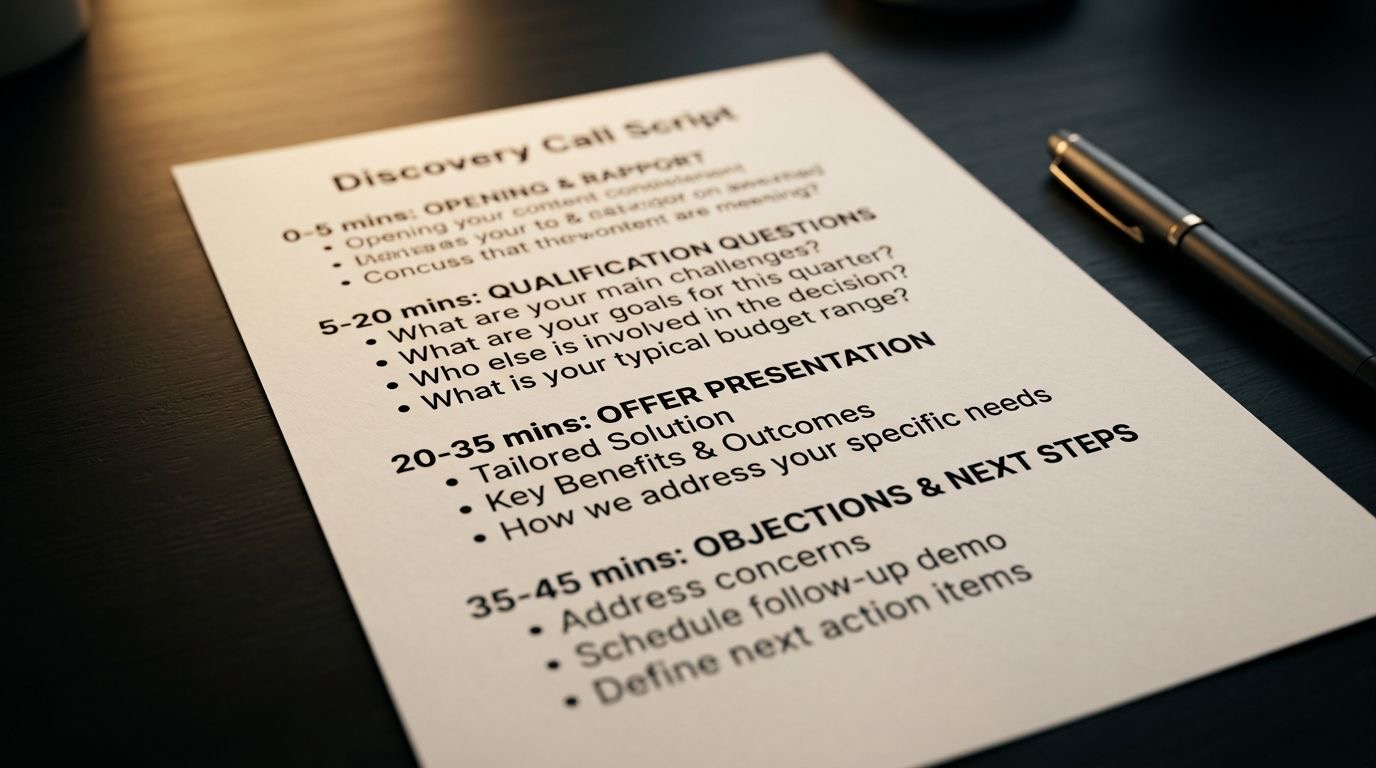
Most coaches don’t lose the sale on the discovery call. They lose it because the call has no shape. You start with good intentions, the conversation wanders, you run out of time, and you either skip the offer entirely or blurt it out in the last ninety seconds. Then you blame yourself for being “bad at sales.”
You’re not bad at sales. You’re missing a structure. This coaching discovery call script prompt builds you a full minute-by-minute call flow and a word-for-word script, tailored to your exact niche, offer, and tone. By the end of this page you’ll also understand why each phase exists, so you can adapt it for any call instead of reading from a sheet.
When to use this
- You’re booking intro or consultation calls but they wander and rarely convert.
- You freeze up at the moment you’re supposed to present your offer and price.
- You want a repeatable structure so every call feels calm and consistent.
- You’re training an associate coach or VA to run intro calls for you.
- You hate “sales-y” scripts and want one that sounds like a real, honest conversation.
The prompt
Copy this whole block into ChatGPT, Claude, or Gemini:
You are an expert coaching sales strategist who has designed discovery calls that enroll clients without pressure. Your job is to build me a complete, repeatable discovery call script and a minute-by-minute structure.

Before writing, ask me up to 3 clarifying questions if anything below is unclear. Otherwise, proceed.

CONTEXT
- My niche: {{NICHE}}
- Who this call is for: {{IDEAL_CLIENT}}
- What I offer at the end: {{OFFER}}
- Call length: {{CALL_LENGTH}}
- My tone: {{TONE}}
- The outcome I want from the call: {{GOAL}}

TASK
Produce two things:

1. A MINUTE-BY-MINUTE STRUCTURE for the whole call, broken into named phases (e.g. Rapport, Current Situation, Desired Outcome, Gap & Stakes, The Offer, Close). For each phase give a time range and one sentence on its purpose.

2. A WORD-FOR-WORD SCRIPT for each phase, including:
   - The exact opening lines that set the frame and put the client at ease.
   - 5-8 specific discovery questions in my niche's language that surface the client's real problem, what they've tried, and the cost of staying stuck.
   - A natural transition into presenting the offer, tied to what they just told me.
   - A clear, no-pressure way to present {{OFFER}} and invite a decision.
   - Calm, honest responses to the 3 most common objections in my niche (e.g. price, time, "let me think about it").
   - A respectful close for both a yes and a not-now.

CONSTRAINTS
- Sound human and match my tone. No high-pressure sales tactics, no fake scarcity, no manipulation.
- Use my niche's real vocabulary, not generic 'business coach' filler.
- Keep the script copy-paste ready: short lines I can actually say out loud.
- Do not invent client results or statistics.

After the script, give me a 5-item pre-call checklist and one sentence on the single most common mistake coaches make on this exact type of call.
How to customize it
Replace the six {{VARIABLES}} before you send it. The more specific your inputs, the less generic the script:
| Variable | What to put | Example |
|---|---|---|
{{NICHE}} |
Your specific coaching niche | career coaching for mid-career women in tech |
{{IDEAL_CLIENT}} |
Who the call is for, and where they’re stuck | senior engineers unsure whether to go into management |
{{OFFER}} |
The exact thing you sell, with price | a 12-week 1:1 career clarity program at $3,200 |
{{CALL_LENGTH}} |
How long the call runs | 45 minutes |
{{TONE}} |
How you want to come across | warm, calm, no pressure |
{{GOAL}} |
The real outcome you want | enroll the right fit, refer the wrong fit out |
See it in action (full example)
Here is the exact prompt, filled in for a career coach. This is the whole input, nothing hidden:
You are an expert coaching sales strategist who has designed discovery calls that enroll clients without pressure. Your job is to build me a complete, repeatable discovery call script and a minute-by-minute structure.

Before writing, ask me up to 3 clarifying questions if anything below is unclear. Otherwise, proceed.

CONTEXT
- My niche: career coaching for mid-career women in tech
- Who this call is for: senior engineers feeling stalled and unsure whether to go into management
- What I offer at the end: a 12-week 1:1 career clarity program at $3,200
- Call length: 45 minutes
- My tone: warm, calm, no pressure
- The outcome I want from the call: either enroll the right people or refer the wrong-fit ones out, with zero hard selling

TASK
Produce two things:

1. A MINUTE-BY-MINUTE STRUCTURE for the whole call, broken into named phases (e.g. Rapport, Current Situation, Desired Outcome, Gap & Stakes, The Offer, Close). For each phase give a time range and one sentence on its purpose.

2. A WORD-FOR-WORD SCRIPT for each phase... [rest of the prompt unchanged]
And here is the complete output the model returns:
Clarifying questions first: 1. Do these calls come from a waitlist/application, or cold from a free lead magnet? (It changes how warm I make the open.) 2. Is the $3,200 pay-in-full only, or do you offer a payment plan I should name on the call? 3. Roughly what percentage of these calls do you currently enroll, so I can pitch the close at the right level of directness?
(Assuming: application-based leads, a 3-pay plan of ~$1,150, and a current close rate around 25%. Adjust if I’m off.)
Part 1 — Minute-by-minute structure (45 min)
Time Phase Purpose 0:00-3:00 Frame & Rapport Set expectations for the call and lower the client’s guard. 3:00-12:00 Current Situation Understand where she is and what’s actually happening. 12:00-20:00 Desired Outcome Get her to describe the future she wants in her own words. 20:00-28:00 Gap & Stakes Surface what’s in the way and the cost of staying stuck. 28:00-30:00 Permission Bridge Ask if she’d like to hear how you’d help. 30:00-38:00 The Offer Present the program tied to what she just said. 38:00-43:00 Objections Answer honestly, no pressure. 43:00-45:00 Close Confirm a yes, or set a respectful not-now. Part 2 — Word-for-word script
Frame & Rapport (0:00-3:00) “Hi Maya, so good to meet you. Before we dive in, here’s how I like to run these: I’ll ask you a bunch of questions about where you are and where you want to go. If it sounds like I can genuinely help, I’ll tell you exactly how, and if it’s not the right fit, I’ll say that too and point you somewhere better. Sound fair?”
Current Situation (3:00-12:00) — discovery questions: 1. “Tell me what’s going on right now that made you book this call.” 2. “Walk me through a typical week. Where does the friction show up?” 3. “You said you’re stalled. Stalled compared to what you expected by now?” 4. “Is the management question something you actually want, or something you feel like you ‘should’ do to keep growing?” 5. “What have you already tried to figure this out, and what happened?”
Desired Outcome (12:00-20:00) 6. “Picture 6 months from now and this is sorted. What’s different about your Monday morning?” 7. “What would landing on the right path do for you outside of work, too?”
Gap & Stakes (20:00-28:00) 8. “What do you think has been keeping you stuck on this?” 9. “If nothing changes and you’re in the exact same spot a year from now, how does that sit with you?”
Permission Bridge (28:00-30:00) “Maya, this is exactly the kind of crossroads I help people work through. Would it be helpful if I walked you through how I’d approach it with you?”
The Offer (30:00-38:00) “What you’re describing isn’t a ‘pick a path in one conversation’ problem, it’s a clarity problem, and clarity comes from structured work over a few weeks. That’s what my 12-week 1:1 program is built for. We meet weekly, map your strengths and what you actually want, pressure-test the management-vs-IC question with real data instead of fear, and leave you with a decision you trust and a plan to act on it. It’s $3,200, or three payments of about $1,150. How does that land?”
Objections (38:00-43:00) – Price: “Totally fair. Let me ask it this way: what’s it costing you to spend another year unsure? If the three-pay makes it workable, that’s exactly why it’s there.” – Time: “It’s 60 minutes a week plus a little reflection. Most clients find it gives them time back, because they stop spinning on the same questions.” – “Let me think about it”: “Of course, this is a real decision. So I understand you fully, is it the investment, the timing, or whether I’m the right person? Whichever it is, let’s talk it through honestly.”
Close — yes (43:00-45:00) “Wonderful. I’ll send the agreement and the payment link right after we hang up, and we’ll book your first session for this week. Welcome aboard, Maya.”
Close — not now “No problem at all. I’ll send you that article on the IC-vs-management decision I mentioned. If you want to revisit this in a few weeks, my door’s open, no pressure either way.”
Pre-call checklist: 1. Re-read her application and note her exact words for her problem. 2. Have the offer, price, and payment plan visible on a sticky note. 3. Silence notifications and have water nearby. 4. Decide your one disqualifier in advance (who you’d refer out). 5. Open with the frame, not small talk that drifts.
Most common mistake on this exact call: Coaches present the offer before the client has said out loud what staying stuck is costing her, so the price sounds expensive instead of obvious.
That is a complete, runnable call. A few tweaks to the wording so it sounds like you, and you can use it on your next booking.
Why this works
Four LLM principles are doing the heavy lifting. Learn them and every prompt you write gets sharper:
- Role priming. The opening line (“You are an expert coaching sales strategist who has designed discovery calls that enroll clients without pressure”) tells the model which slice of its knowledge to use. “Write me a sales script” pulls the generic, pushy internet average. Priming an honest, no-pressure expert pulls the consultative version you actually want.
- Specificity in, specificity out. The script can only be as concrete as your inputs. A vague niche gives you a vague “so, tell me about your goals” script. Feeding it the real client (“senior engineers unsure about management”) forces questions in your client’s actual language, like the IC-vs-management line. The output is capped by the quality of your
{{NICHE}}and{{IDEAL_CLIENT}}. - Constraints are quality control. The “no high-pressure tactics, no fake scarcity, no manipulation” lines aren’t decoration. Each one removes a failure mode the model would otherwise default to, because most sales copy it learned from is pushy. Telling it what NOT to do is as powerful as telling it what to do.
- Clarifying questions before output. The “ask up to 3 clarifying questions first” line lets the model fill gaps by asking instead of guessing. Notice how its questions about lead source and payment plan completely change the script. That single line is the biggest fix for generic AI output.
Do this now
- Copy the prompt above into ChatGPT or Claude.
- Replace the six variables with your real niche, client, offer, call length, tone, and goal.
- Send it. Answer its clarifying questions honestly, that’s where the quality comes from.
- Read the script out loud once. Swap any line that doesn’t sound like you, then use it on your next call.
Pro tips
- Feed it your client’s exact words. Paste a sentence from a real application or DM. The model will mirror that vocabulary back into the discovery questions, and it’ll sound uncannily like your world.
- Generate two versions of the close. Ask for one slightly more direct and one softer, then keep whichever matches your comfort level. You’ll relax, and relaxed closes convert.
- Ask it to list disqualifiers. Add “and tell me 3 signs this person is NOT a fit” so you protect your calendar and refer the wrong people out cleanly.
- Turn it into a one-page cheat sheet. Once you like the script, ask the model to compress the structure into a single-page bullet outline you can glance at mid-call instead of reading.

0 comments
No comments yet.