
Title: How to ask coaching clients for testimonials without making it awkward
A client finishes a coaching container and says, “This was really helpful.”
You appreciate hearing it. You also know that a sentence like that could help someone else understand what your coaching is like. Then the tension appears: you need proof, but you do not want the client to feel used.
That tension is reasonable. A testimonial request can feel awkward when it arrives as a favor the client has to perform, or when it treats a private coaching relationship as automatic marketing material.
The better path is to ask for a reflection first, then ask for clear permission. A good testimonial process gives the client structure, privacy choices, and control over their own words. It also protects the truth of the work. Testimonials should make your coaching clearer, not bigger than it was.
This belongs inside [professional coaching boundaries](internal-link:cg-article-016). The client’s words, context, and privacy still matter after the final session.
What a coaching testimonial is for
A coaching testimonial should help a future prospect evaluate fit. It is not there to prove that every client gets the same result. It is not there to make your work sound more dramatic than the client experienced it.
Useful proof answers practical questions a prospect may already be asking:
- What was happening before this client started coaching?
- What changed during the work?
- What part of the process helped?
- What can the client do more clearly now?
- What kind of person might find this coaching useful?
That is different from collecting praise.
“She was amazing” may be kind and sincere, but it does not tell a prospect much. It does not name the starting point, the work, the change, or the kind of coaching relationship involved.
Stronger proof is usually specific and modest. It might show that a first-time manager prepared better for feedback conversations, that a career client narrowed their target roles, or that a client stopped rebuilding their whole routine every Monday and chose one workable rhythm instead.
Those examples do not promise a guaranteed transformation. They give a future client a clearer picture of what the coaching helped with in one real context.
Why vague asks create vague proof
The weakest testimonial request is usually the simplest:
“`text
Could you write me a testimonial?
“`
There is nothing wrong with wanting the testimonial. The problem is that the client now has to guess what you need. Should they write a polished endorsement? Should they mention personal details? Will it be public? Should they talk about results, the process, or how they felt about you?
That uncertainty often produces vague praise.
Weak:
“`text
Elena was amazing.
“`
Stronger:
“`text
Before coaching, I was avoiding feedback conversations with my new team. Over six weeks, I created a clearer feedback rhythm and felt more prepared for one-on-ones.
“`
The stronger version is more useful because it stays close to the client’s actual experience. It names the situation, the movement, and the part of the work that mattered. It does not suggest that the coaching fixed the client’s whole leadership career.
Specific proof is also more respectful. It lets the client describe what changed instead of trying to perform enthusiasm for your website.
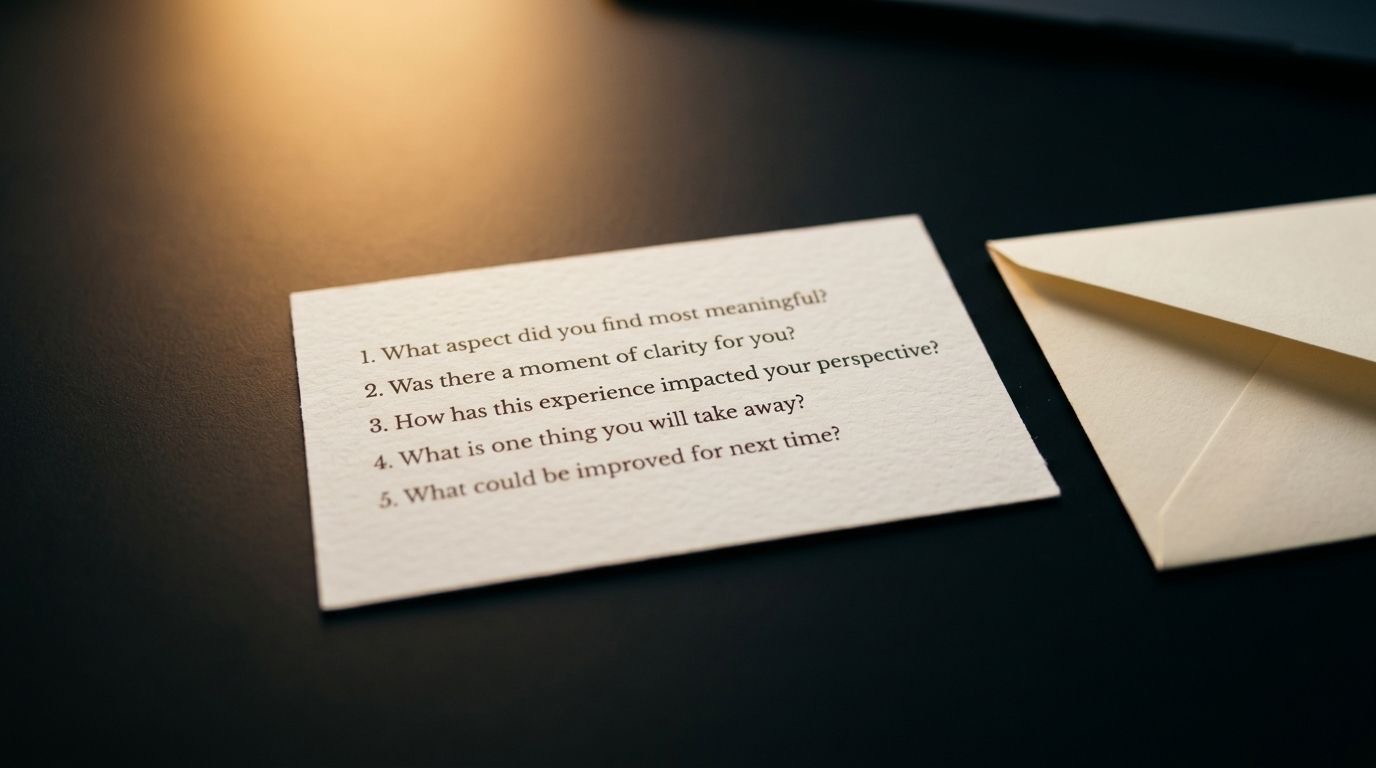
Send five reflection questions
Instead of asking for a testimonial cold, ask for a short reflection.
Use these five questions:
“`text
- What was happening before we started?
- What changed during the work?
- What felt most useful?
- What can you do now that felt harder before?
- What would you say to someone considering this coaching?
“`
Each question has a job.
The first question captures context. “I was struggling” is less useful than “I had just become a manager and was avoiding feedback with former peers.”
The second captures movement. Movement does not have to be dramatic. It may be a clearer decision, a steadier habit, a better conversation, a weekly rhythm, or a more grounded next step.
The third shows process. A prospect may want to know what actually happens in coaching. Was it reflection, practice, accountability, a framework, or structured space to think?
The fourth turns praise into capability. “I feel more confident” becomes more useful when the client can say where that confidence now shows up.
The fifth gives the client room to recommend the work in their own language. Sometimes the most useful line is not “Hire this coach.” It is more grounded: “Come prepared to do the work between sessions” or “This helped because I needed structure, not just encouragement.”
Ask for permission in layers
Permission is not implied because a client said something kind.
If a client says during a closing session, “This was so helpful,” do not copy that sentence onto your website. Ask first. Ask clearly. Give the client real options.
Useful permission choices include:
- Private feedback only.
- Anonymous proof.
- First name only.
- Initials.
- Full name.
- Role or title.
- Company name.
- Photo.
- LinkedIn recommendation.
- Website, sales page, email, proposal, or social post use.
- Fuller case story use.
These choices are not interchangeable.
Permission to use a sentence anonymously is not permission to use the client’s full name. Permission to use a quote on LinkedIn is not automatically permission to place it on a sales page. Permission to keep feedback privately is not permission to use it publicly later because it would be convenient.
Confidentiality also needs judgment. A career client may not want their employer context public. A leadership client may not want team details shared. A wellness-adjacent client may not want routines, personal context, or health-related details published.
Even anonymous proof can identify someone if the details are too specific. If a role, company stage, timing, location, or personal situation points back to one person, the story may not be meaningfully anonymous.
The tradeoff is simple: the more detailed the proof, the more useful it can be, but the more care it needs. Client control is not a barrier to good proof. It is what keeps the proof trustworthy.
Use this testimonial request script
Ask after a closing reflection or a clear value moment, not out of nowhere.
“`text
Hi Sarah,
I appreciated the way you reflected on the progress you made during our closing session. I am collecting client reflections so I can describe the coaching more clearly and honestly.
Would you be open to answering five short questions? You can choose whether your answers are public, anonymous, or private feedback only. No pressure either way.
“`
Then include the five questions:
“`text
- What was happening before we started?
- What changed during the work?
- What felt most useful?
- What can you do now that felt harder before?
- What would you say to someone considering this coaching?
“`
After the client answers, ask for the specific permission you need:
“`text
Thank you for sharing this. If I wanted to use one short excerpt, would you prefer full name, first name only, initials, anonymized, or private-only?
“`
If you edit the quote for length, clarity, grammar, or confidentiality, send the edited version back:
“`text
I lightly edited this for length and clarity without changing the meaning. Are you comfortable with this version being used publicly on [website/LinkedIn/sales page]?
“`
If you want a LinkedIn recommendation, keep that as a separate request:
“`text
Would you be comfortable writing a short LinkedIn recommendation focused on the specific change you experienced and what part of the process helped most? If you prefer not to make anything public, no problem at all.
“`
The pattern matters. You explain why you are asking. You make the reflection easier. You give privacy options. You make it clear that no is acceptable.
That is what keeps the ask from becoming pressure.
Turn broad praise into useful proof
Sometimes a client gives you a sentence that is sincere but too broad to use well. Do not rewrite it into a bigger claim. Ask a follow-up question that helps the client get more specific.
Vague:
“`text
The coaching was powerful.
“`
Helpful follow-up:
“`text
What made it feel powerful?
“`
Stronger:
“`text
The coaching was powerful because I stopped avoiding one specific decision and created a weekly rhythm for acting on it.
“`
Vague:
“`text
I felt supported.
“`
Helpful follow-up:
“`text
What did support look like in practice?
“`
Stronger:
“`text
I felt supported because each session ended with one clear action, and I knew what to focus on between calls.
“`
Vague:
“`text
I gained confidence.
“`
Helpful follow-up:
“`text
Where did that confidence show up?
“`
Stronger:
“`text
I gained confidence in one-on-ones because I practiced the first sentence of hard conversations before having them.
“`
This is the difference between polishing and distorting. You can help a client name the details. You should not make their experience sound more dramatic than they described.
Build small case stories with care
A case story is a longer form of proof. It can be helpful when a short quote does not give enough context.
Use four parts:
“`text
Context: What was happening before?
Process: What did the coaching help the client clarify, practice, decide, or build?
Change: What changed in behavior, clarity, rhythm, decision-making, or follow-through?
Boundary: What context keeps the story honest and avoids implying a guaranteed result?
“`
Example:
“`text
A first-time manager was avoiding feedback with former peers. In coaching, they clarified the role shift, practiced language, and created a weekly feedback rhythm. They began preparing conversations more clearly and following up with less avoidance. This reflects one client’s context, not a guaranteed outcome.
“`
That example is not dramatic. That is part of why it works.
It gives a prospect a picture of the coaching without pretending the work fixed everything. It also keeps the result in a responsible frame: this happened in one client’s context.
Use anonymized stories only with care and permission. If a story includes role, industry, company stage, location, timing, or personal details, ask whether the client could still be recognized. If yes, remove or generalize details, then get approval on the final version.
Know what you can edit
Clients may send long paragraphs, bullet points, or voice notes. You do not have to publish their first draft exactly as written if they give you permission to shape it. But the line is clear.
You can edit for grammar, length, clarity, and confidentiality. You can remove identifying details. You can shorten a long paragraph into a tighter quote.
You should not edit by changing the meaning.
Do not turn “I felt more prepared” into “I became a confident leader.” Do not remove context that changes the claim. Do not edit mixed feedback into pure praise. Do not make an exceptional outcome sound typical. Do not add claims the client did not make.
Always send the final version back for approval before publishing.
“`text
Here is the version I would like to use. I edited for length and removed the team detail for privacy. Does this still feel accurate to your experience, and are you comfortable with me using it on my website?
“`
If the client says, “Actually, I would rather keep that part private,” remove it. Do not argue. Do not explain why it was the strongest line. The proof is not worth damaging the trust.
Keep a proof log
Future you will not remember which version a client approved or where it was allowed to appear.
Create a simple proof log. A spreadsheet is enough. Track the client name, date received, original words, edited approved version, permission level, approved platforms, and confidentiality notes. If the client was free, discounted, beta, or materially different from your standard offer, note that too.
This prevents accidental misuse. It also helps you see patterns in your delivery.
If several clients mention that the most useful part was practicing language before a hard conversation, that tells you something. If several clients say the first session was unclear, that tells you something too.
Not every piece of feedback should become marketing. Some feedback is for improving the work. Proof starts as listening.
Be careful with beta clients and special contexts
Early coaches often collect proof from beta clients, discounted clients, pilot programs, or people they already know. That does not make the feedback useless. It does mean context matters.
If someone received free coaching, a discount, or another meaningful benefit, be careful not to present the testimonial in a way that creates a misleading impression. In some contexts, disclosure may be needed. This article is not legal advice. As a professional standard, keep testimonials truthful, specific, permission-based, and clear about relevant context.
The safest path for a new coach is usually specific qualitative proof: a clearer decision, a better preparation rhythm, a more useful conversation, a practical habit, a grounded plan, or a clearer way to explain a goal.
Be careful with proof that suggests income, job outcomes, health outcomes, or guaranteed transformation. Even when a client says something dramatic, you still have responsibility for the impression your marketing creates.
Mistakes that damage trust
Do not ask before real value has been created. A testimonial request too early in the relationship can feel extractive.
Do not ask during an unresolved client experience just because you need proof. If something needs repair, repair the experience first.
Do not use a kind session comment without permission. A spoken appreciation inside the coaching relationship is not automatically marketing copy.
Do not push every client toward a public, full-name testimonial. Some clients have good reasons to stay anonymous or private.
Do not hide context when it matters. If the work was free, discounted, beta, or materially different from your standard offer, be careful about how the proof is presented.
Do not turn broad praise into a bigger claim. “This helped me prepare for difficult conversations” should not become “This coaching transformed my leadership.”
Do not publish anonymous stories with identifying details. Anonymous proof still needs privacy judgment.
Do not treat feedback only as marketing material. Mixed feedback may be more useful for improving delivery than for your website.
And do not use testimonials as a substitute for a clear offer. Proof can support trust, but it cannot do the work of explaining who you help, what the coaching is for, and what the client can expect from the process. If that part is still vague, use [the coaching offer clarity checklist](internal-link:cg-article-004) before asking testimonials to carry too much weight.
What to do before you ask your next client
Prepare the structure before you need it.
Write your five reflection questions. Save one respectful request email. Decide what permission options you will offer. Create a simple proof log with columns for the original words, approved version, permission level, and approved platforms.
Then choose one appropriate client or beta client and ask after a closing reflection or clear value moment.
The goal is not to pressure someone into public praise. The goal is to help the client reflect honestly, protect their control over their own words, and capture specific proof that helps a future prospect understand the work.
Once a client can describe what changed, asking for referrals also becomes easier because the right-fit person is clearer. But that comes after the same standard: client trust first, useful proof second, marketing convenience last.



0 comments
No comments yet.