

Title: How to deliver coaching professionally with your first client
The client said yes, now the responsibility begins
Your first paid client can create two feelings at once: relief that someone trusted you, and pressure to prove they were right.
That pressure often turns into a private standard no coach can meet: every session should feel brilliant, every question should land, and the client should leave each call with a major breakthrough. A better standard is more responsible and more useful. Your job is to create a clear, respectful container where real coaching can happen.
Delivery is where marketing becomes real. The client is no longer experiencing your promise through your website, your post, or the sales conversation. They are experiencing it through how the work begins, how expectations are held, how sessions are run, how progress is discussed, and how the engagement closes.
If you have not clarified scope, confidentiality, roles, communication norms, and limits yet, start with the [professional coaching boundaries checklist](/professional-coaching-boundaries-checklist/). This article focuses on what happens after the client says yes: how to deliver the first engagement professionally without overbuilding the process or pretending to be more established than you are.
Why delivery feels shaky for new coaches
New coaches often confuse professionalism with performance. They try to sound impressive, ask perfect questions, create a dramatic insight every hour, or build a polished client portal before they have enough real client experience to know what the portal should do.
The opposite mistake is just as common. The coach wants the work to feel personal, spacious, and responsive, so everything is improvised. The client books a session, shows up, talks for an hour, and leaves with a warm feeling but no clear sense of the coaching container.
Warmth matters. Presence matters. But the client should not have to guess how the relationship works. They should know when sessions happen, what to do before the first session, whether between-session messages are included, how cancellation works, what support is inside scope, what happens when a topic falls outside coaching, how progress will be discussed, and what they are responsible for between calls.
Uncertainty becomes a client-experience problem when the client has to carry it. A professional container does not remove the human quality of coaching. It protects it.
Structure is not a script
A script tells you exactly what to say even when the moment calls for something else. A structure helps both people stay oriented while real coaching unfolds.
That distinction matters. If a client brings something emotional but still within coaching scope, you do not push through your planned questions just to stay on schedule. You slow down. If a client brings something outside coaching scope, you clarify the boundary and, when appropriate, refer them to qualified professional support.
The tradeoff is simple: too little structure makes the client do unnecessary interpretive work, while too much structure can flatten the conversation. Professional delivery sits in the middle. The client knows what the engagement is for. The coach remembers what was agreed. Sessions have a rhythm. Actions are specific enough to revisit. Feedback is invited before disappointment gets quiet. The ending helps the client integrate what happened.
That is the standard for a first paid client: clear, consistent, and respectful.
Send a simple onboarding note
Delivery begins before the first session. You do not need a large onboarding system. You need a warm, clear start that answers the questions the client should not have to ask.
Your onboarding note should cover the basics: welcome, next steps, agreement or terms, session dates, session length, video link or location, time zone, payment confirmation, cancellation expectations, communication expectations, confidentiality and coaching scope at a high level, and pre-session reflection questions.
For agreements, confidentiality language, payment terms, cancellation policies, and data handling, use proper professional guidance where needed. This article is not legal advice. The practical point is that these topics should be clear before the work begins.
Here is a simple welcome note:
“`text
Welcome. I am glad we will be working together.
Before our first session, please review the agreement, confirm the schedule, and answer the short reflection questions below. In our first session, we will clarify your goal, define where we are starting, and agree on how we will work together.
“`
That is enough. It does not need to sound like a large company wrote it. It needs to help the client feel oriented.
Ask reflection questions before the first session
The first session should not start in fog.
Pre-session reflection helps the client arrive with useful context. It also keeps you from spending the first 30 minutes trying to discover why the client is there.
Use a short set of questions:
- What made you decide to start now?
- What would make this coaching worth your time and attention?
- What do you want to be different by the end?
- What have you already tried?
- What tends to get in the way?
- How do you prefer to be supported when you feel challenged?
- What should I know about your communication style?
These questions do not mean the client runs the entire process. They mean the coaching alliance is co-created. You are learning how this person thinks, where they want support, and what kind of container will help them participate responsibly.
The communication-style question is especially practical. Some clients want direct challenge. Some need time to process before answering. Some appreciate written notes. Some feel overwhelmed by too many resources. You do not have to guess. You can ask.
Give the first session a setup job
A new coach may want to jump into coaching immediately to prove value. The impulse makes sense, but it can weaken the engagement.
The first session can include coaching. It should also build the container.
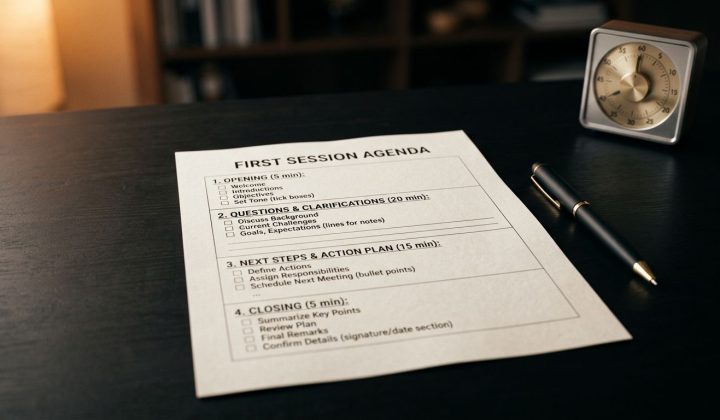
A simple first-session agenda can include reconnecting to why the client started, clarifying the goal for the engagement, defining the baseline, agreeing on communication and between-session work, and choosing the first action.
You might open the session this way:
“`text
Today I want us to clarify the goal for this coaching container, name where things are starting, and decide what would make the work useful. We may begin coaching today, but I also want to make sure the structure is clear.
“`
That line lowers your pressure to perform magic in the first hour. It also helps the client understand that the first session has a purpose beyond conversation.
Name the baseline so progress can be discussed honestly
Baseline is not judgment. It is current reality.
Without a baseline, you may reach the end of the engagement and struggle to talk about progress in a grounded way. The client may have changed, but neither of you has clear language for what moved. That is when coaches can drift into vague encouragement.
You do not need to measure everything. You do need to name the starting point clearly enough that you can return to it later. A useful baseline includes the current situation, desired outcome, success signals, obstacles, and client responsibility.
For a leadership coaching client, the baseline might look like this:
Current situation: “I just became manager of former peers, and feedback conversations are too soft.”
Desired outcome: “I want to communicate expectations clearly without becoming harsh.”
Success signals: “I prepare feedback before conversations, name the issue directly, follow up, and reduce over-apologizing.”
Obstacles: “Fear of damaging relationships, lack of practice, and unclear role boundaries.”
Client responsibility: “Bring real situations, practice between sessions, and reflect honestly on what happened.”
That baseline does not guarantee a transformation. It gives coach and client a responsible way to discuss movement. Later, the client may say, “I am preparing differently. I am saying the first sentence more clearly. I am recovering faster after hard conversations.” That is more useful than a vague “I feel better.”
For a career coaching client, the baseline could be simpler:
Current situation: “I am applying to roles and not getting interviews.”
Desired outcome: “I want clearer positioning and more focused applications.”
Success signals: “I can explain my transition more clearly, choose better-fit roles, revise my story, and do more thoughtful outreach.”
Obstacles: “Vague direction, discouragement, and reactive applications.”
Client responsibility: “Do the writing, outreach, and reflection between sessions.”
Again, this is not a promise that coaching will produce a specific career result. It is a way to keep the work honest and concrete.
Use a simple session rhythm
A session rhythm gives consistency without making every session identical. Use it lightly. Let it guide the work, not flatten it.
A simple rhythm:
- What changed since last time?
- What matters most today?
- What is the real challenge here?
- What insight is emerging?
- What action will you take?
- What support or accountability is needed?
This rhythm helps you avoid two weak patterns. One is wandering conversation, where the session feels pleasant but does not land anywhere. The other is coach performance, where you ask too many questions, offer too many reflections, or try to create insight by force.
The client should feel that the session has room and direction. They can bring what is real, and you can help them turn the conversation into learning, decision, practice, or action.
If the client is emotional, slow down. If the client brings an urgent matter that is within coaching scope, stay present and use the rhythm gently. If the issue belongs with a therapist, attorney, doctor, financial professional, or another qualified provider, name the boundary and refer appropriately.
Boundaries do not weaken the coaching. They protect trust.
Make between-session actions specific
Coaching does not only happen during the call. The session can create insight, but the client’s life is where the work gets tested.
That is why between-session actions should be specific, realistic, and connected to the goal. Vague action sounds supportive but gives the client little to do.
Weak: “Be more confident this week.”
Better: “Before your next one-on-one, write the expectation in one sentence and say it without apologizing.”
Weak: “Work on your career clarity.”
Better: “Review ten job descriptions and highlight the phrases you want your next role to include.”
Weak: “Prioritize yourself.”
Better: “Choose one evening this week where work ends at 6:30, and write down what made that easy or difficult.”
The client should leave knowing what they are practicing, observing, deciding, or doing. If the action is too large, shrink it. If it is too vague, make it observable. If the client does not understand why it matters, connect it back to the goal.
Your notes can stay simple: goal, key insight, action, obstacle, and follow-up point. Do not write a novel. Do not store sensitive information casually. Follow the confidentiality and data-handling commitments you made in your agreement and onboarding. The purpose of notes is continuity, not collecting more personal detail than the work requires.
Keep the operating system lean
Professional does not mean complicated.
A new coach can easily hide inside infrastructure: a portal, a dashboard, a library of worksheets, automatic reminders, branded forms, and a client hub with more tabs than the client will ever open.
Tools can help later. They are not the foundation.
For your first client, a lean operating system is enough:
- One folder
- One agreement
- One reflection form
- One shared goal document
- One place for actions
- One midpoint feedback question set
- One closing reflection
If you want the absolute minimum, use three documents.
The first is a welcome and logistics document. It includes the schedule, links, communication norms, cancellation expectations, and what to do before the first session.
The second is a goal and baseline document. It names the current situation, desired outcome, success signals, obstacles, and client responsibilities.
The third is a session notes and action tracker. It records the date, focus, insight, action, accountability, and follow-up point.
That is enough to start. As you work with more clients, improve the system based on real friction. If every client asks the same question, add that answer to onboarding. If clients forget actions, make the tracker clearer. If midpoint feedback shows that people need more structure, adjust the rhythm.
Do not build a system for imaginary clients. Build enough structure to serve the client in front of you well.
Ask for midpoint feedback before disappointment gets quiet
Midpoint feedback can feel exposed for a new coach. It may sound like asking, “Am I doing a good job?”
That is not the purpose.
The purpose is to check the container while there is still time to improve it. Feedback is easier to use before the client has quietly disengaged.
Halfway through the engagement, ask:
- What has been most useful so far?
- What should we adjust?
- What feels unclear?
- What progress are you noticing?
- What do you want to focus on for the remaining sessions?
You can frame it this way:
“`text
We are halfway through the sessions, so I want to check the container before we keep going. What has been most useful so far, what feels unclear, and what should we adjust for the remaining sessions?
“`
If the client says, “The sessions are helpful, but I sometimes leave with too many ideas,” do not defend yourself.
Try:
“`text
That is helpful to know. For the remaining sessions, would it help if we ended with one primary action instead of several options?
“`
If the client says, “I like the conversations, but I am not sure I am making progress,” return to the baseline.
“`text
Let’s go back to the baseline we set. When we started, you wanted to prepare feedback conversations more clearly and stop softening the message. Where do you see movement, and where does it still feel the same?
“`
That is why the baseline matters. Without it, you may be tempted to reassure the client with, “But I think you are doing great.” Kindness is good. Grounded reflection is better.
If feedback reveals that the work is unclear, adjust focus. If expectations were mismatched, clarify them. If the client needs support outside coaching scope, name that with care and point them toward appropriate professional help.
Feedback is not only for the coach’s confidence. It is for the quality of the work.
Close the engagement intentionally
The final session should not simply fade out.
Closing reflection is part of delivery. It helps the client integrate the work, see what changed, and name what remains unfinished. It may also make later testimonial or referral conversations more grounded, but it is not the testimonial ask itself.
Use questions like:
- When we started, what was the main challenge?
- What is different now in how you think, decide, or act?
- What did you learn about yourself?
- What can you now do that was harder before?
- What remains unfinished?
- What support do you need next?
These questions help the client leave with a clearer understanding of the engagement. They also help you learn what your coaching actually supported, without exaggerating the result.
Good closing is not pressure for renewal. It is respect for the work that happened.
Common mistakes to avoid
The first mistake is treating payment as the finish line. It is the beginning of responsibility. The client has trusted you, and now your job is to make the experience clear enough to hold that trust.
Another mistake is starting the first session without onboarding. A client should not have to discover the schedule, scope, communication norms, cancellation expectations, and between-session process by accident.
New coaches also try to create a dramatic breakthrough in the first hour. A useful first session may be quieter than that. It may clarify the goal, name the baseline, and identify the first honest action. That is not a lesser result. It is a professional beginning.
Skipping the baseline is another problem. If you never name the starting point, progress becomes harder to discuss without overclaiming or relying on vague encouragement.
Vague between-session actions weaken the work. “Think about it,” “be more confident,” and “prioritize yourself” may sound supportive, but they do not give the client a clear practice.
Waiting until the final session to ask for feedback is also risky. By then, disappointment may already be settled. Midpoint feedback gives both people a chance to adjust.
Overbuilding is the quieter mistake. You do not need a complex backend to deliver professionally. A simple system used consistently is better than a polished system that distracts from the work.
Finally, be careful with notes. Client information deserves care. Keep what you need for continuity, store it responsibly, and follow the confidentiality and data-handling commitments you made.
What to prepare before the first session
Before your next first client session, prepare five things:
- A welcome note with logistics, expectations, and next steps
- A short pre-session reflection form
- A first-session agenda that clarifies goal, baseline, communication, and first action
- A simple session notes and action tracker
- A midpoint feedback prompt and closing reflection questions
That is enough to begin professionally.
Your client does not need you to act like you have coached hundreds of people if you have not. They need you to be prepared, honest, attentive, and consistent.
Do not fake seniority. Build professionalism.
If you have not already done it, review the [professional coaching boundaries checklist](/professional-coaching-boundaries-checklist/) before sending your onboarding note. Clear delivery works best when the scope of the relationship is already understood.
The larger CoachGuido Client Acquisition System connects this delivery work to the rest of the business path: offer clarity, respectful conversations, clean follow-up, professional delivery, proof, referrals, and repeatable execution. Delivery is not separate from client acquisition. It is where your promise becomes real.


0 comments
No comments yet.