
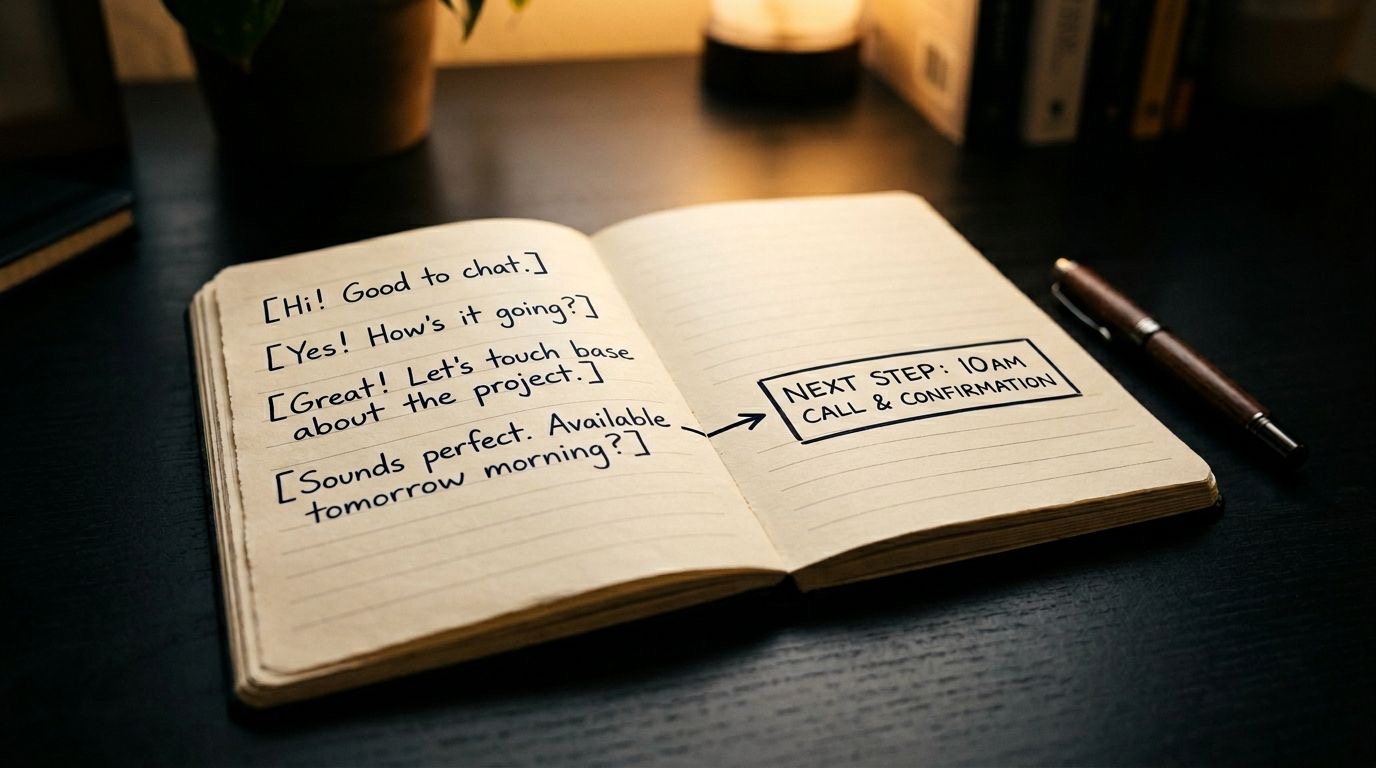
Title: How to ask for the next step in a coaching conversation
Category slug: `sales-closing`
Source files used:
- `/home/coachguido/base/scripts-discussions/part-12-discussion.md`
- `/home/coachguido/base/marketing-kit/03-messaging-framework.md`
- `/home/coachguido/base/marketing-kit/02-personas-and-buying-triggers.md`
- `/home/coachguido/base/marketing-kit/13-claims-and-ethics-guardrails.md`
- `/home/coachguido/base/marketing-kit/07-hooks-and-headlines-bank.md`
- `/home/coachguido/agent/07-editorial-voices-elena-david.md`
Internal link suggestions:
- Link to the pillar in the first third: `The respectful sales conversation checklist for new coaches`
- Link to related supporting article: `How to turn a friendly chat into a coaching opportunity`
- Link to related supporting article: `How to explain your coaching offer in 90 seconds`
- Link to related supporting article: `What to do when a prospect says “not now”`
- Link to related supporting article: `How to follow up without sounding desperate`
- Link to offer pillar where relevant: `The coaching offer clarity checklist`
The awkward moment after the offer
The awkward moment often comes after the useful part.
You have listened. You have asked a real question. The person has described a problem your coaching may address. You have asked permission to explain how you help, and they have said yes. You have given a short explanation of the offer.
Now the conversation is quiet for half a second, and you need to name what happens next.
This is where many new coaches drift. They keep explaining, send another resource, soften the invitation, or hope the other person will ask for the call. Some do the opposite and make the next step too large for the conversation: a full enrollment conversation after one comment, a long application after a short DM, or a pressured “are you ready to start?” before fit is clear.
Neither move protects trust.
This article supports the broader [respectful sales conversation checklist for new coaches] by focusing on one specific moment: how to ask for the concrete next step after relevance, consent, and a brief offer explanation are already in place.
Permission and next step are different asks
Two questions often get blended together.
The first question is permission to explain the offer:
“Would it be useful if I shared how I usually help with this?”
The second question is the operational next step:
“Would you like to schedule a 20-minute fit call so we can see whether this support is appropriate?”
They do different work.
The permission question protects the person from receiving an unwanted pitch. The next-step question protects the conversation from becoming vague after the offer has been named.
If you skip permission, the offer can feel sudden. If you skip the next step, the person may leave with a pleasant impression and no clear way to continue. Ethical selling needs both: consent before you explain, then clarity about what happens next.
For the earlier moment, link to `How to turn a friendly chat into a coaching opportunity` when that article is available. This article starts after that bridge has already done its job.
Ask when the invitation is relevant
You do not need perfect certainty before asking for a next step. You do need enough clarity that the invitation makes sense.
Before you ask, check three things:
- The person has named a problem, goal, decision, or situation your coaching actually addresses.
- They have agreed to hear how you help, or they have directly asked how your coaching works.
- You have explained the offer briefly enough that they understand what you are inviting them toward.
If those pieces are not present, slow down. Ask one clarifying question, offer a useful resource, or let the conversation end cleanly. A detailed answer is not consent. A warm reply is not a buying signal. A person can be expressive, curious, or grateful without wanting coaching.
That boundary is not hesitation. It is part of the work.
Choose the smallest honest next step
A next step is not always “book a call.”
Sometimes a call is right. Sometimes the cleaner next step is a resource, a short follow-up, a paid intake, a proposal, an application, or a referral to someone better suited to the situation. The size of the next step should match the maturity of the conversation.
If someone has only commented on a post, a full sales call may be too much. If they have already described the issue, asked about your work, and said they want help, a fit call may be appropriate. If they are asking about support for a team, a proposal or scoping conversation may be more respectful than a casual scheduling link.
Common next steps include:
- A short fit call
- A paid intake or strategy session
- A simple application or pre-call questionnaire
- A proposal for organizational or team coaching
- A scheduling link for a specific type of call
- A resource with an agreed follow-up date
- A referral to a better-fit professional or support option
- A clear end to the conversation when there is no fit
The guiding question is not, “How do I move this person closer to buying?”
The better question is, “What is the next honest step that helps both of us understand whether this support is appropriate?”
That question creates a useful tradeoff. A smaller next step may feel less decisive, but it often protects trust when the conversation is still early. A larger next step can be appropriate when fit is clearer, but it should not be used to manufacture commitment before the person has enough information.
Use a four-part invitation
A clean next-step ask has four parts:
- Name what you heard.
- Connect it to the support you offer.
- Suggest one specific next step.
- Leave the person a real choice.
For example:
“From what you described, the main issue seems to be giving feedback clearly without damaging the working relationship. That is a situation I help new managers practice. The next step I would suggest is a 20-minute fit call where we can look at whether coaching is appropriate. Would you like me to send you a couple of times?”
This works because the invitation is specific. It names the problem, connects to the coaching offer, and gives the person a choice.
It also avoids the common pressure points. The coach is not promising an outcome, intensifying pain, or pretending the call is only for the other person’s benefit. It is a business conversation with a professional boundary, and it can still be warm.
Scripts for the exact next-step ask
Use these as starting points. They should sound like your voice, not like a script you copied into the conversation.
After a brief offer explanation
“That is the kind of situation my coaching is designed for. If you want to explore fit, the clean next step would be a short call where we look at what is happening, what support would be useful, and whether this is the right container. Would you like to schedule that?”
When the person has asked how you work
“I usually start with a short fit conversation before recommending anything. That gives both of us a chance to see whether coaching is appropriate here. Would you like to set that up?”
When the conversation is warm but still early
“This may be early for a full coaching conversation, but it does sound related to the work I do. Would a short call be useful, or would you rather I send one resource first?”
When a paid intake is the right step
“For this kind of situation, I do not try to solve it in messages. The best next step would be a paid intake session where we can look at the context properly and decide what support makes sense. Would you like the details?”
When a proposal is more appropriate
“Since this involves your team, I would not want to improvise a recommendation here. The next step would be for me to send a short proposal with scope, format, and boundaries. Would that be useful?”
When they are not ready
“Of course. We do not need to force a decision. If it becomes relevant later, I am happy to revisit it.”
That last script matters. A clear ask is only respectful if the person can say no, not now, or I need to think about it without being argued with.
Match the ask to the setting
The same invitation will not work in every context. A live call, a DM, a referral introduction, and an event conversation each carry different expectations.
On a live call
A live call gives you more room to summarize what you heard and make a recommendation.
“Based on what you shared, I can see a possible fit, but I would want to look at the details before saying yes. The next step would be a separate fit call focused on your goals and whether my coaching is the right support. Would you like to schedule that?”
If you are already on a formal fit call, the next step may be a coaching agreement, session options, or a follow-up email with details:
“The next step would be for me to send the coaching agreement and session options so you can review them without pressure. Would you like me to do that?”
Do not hide the practical details. If there is a price, timeline, intake form, agreement, or decision point, name it plainly.
In a DM conversation
DMs can become accidental free coaching quickly. Keep the next step short and bounded.
“This is probably better handled in a short call than in messages. If you want to explore whether coaching would fit, I can send you a scheduling link.”
Or:
“I can share one resource here, and if you want more direct support, the next step would be a fit call.”
This protects both people. The prospect does not have to decode your availability, and you do not keep providing unpaid support without a container.
After a referral introduction
Referral conversations need extra care because trust has been borrowed from someone else.
“I am glad we were introduced. From what you shared, it sounds like there may be a fit, but I would not want to assume. The clean next step would be a short conversation where we both decide whether coaching is appropriate. Would you like to set that up?”
A referral opens a door. It does not obligate the person to continue.
In a content comment
A public comment is rarely the place for a full invitation.
If someone comments, “This is exactly what I am dealing with,” you might reply:
“That is a real situation. If you want to say a little more, feel free to send me a message and I can point you to the right next step.”
Once the conversation is private and relevance is clearer, then you can suggest a resource, a fit call, or a clean ending.
At an event
Event conversations are often warm but scattered. People are moving between rooms, remembering names, and holding several conversations at once. A simple follow-up is usually better than a heavy invitation.
“This sounds related to the coaching work I do. Would it be useful if I followed up tomorrow with a short note and a possible next step?”
This gives the person space. It also gives you a real reason to follow up.
With an existing relationship
Existing relationships can feel more awkward because the person knows you outside the coaching context.
Make the boundary visible:
“I am saying this with the coaching hat on for a moment. What you are describing is close to the work I do with clients. If you ever want to explore that formally, the right next step would be a fit call. No pressure either way.”
The word “formally” helps. It signals that coaching is not the same as casual support from a friend, colleague, or peer.
Examples from common coaching conversations
New manager coaching
Prospect:
“I just got promoted and managing former peers is harder than I expected.”
Coach:
“That makes sense. When someone becomes the manager of former peers, the hard part is often renegotiating closeness, authority, and feedback. Which part is most uncomfortable right now?”
Prospect:
“Feedback. I keep softening everything.”
Coach:
“That is a situation I help new managers work through. I do not think we should try to solve the whole thing here, but a useful next step would be a short fit call to see whether coaching would help you practice those conversations. Would you like to schedule one?”
The invitation names the issue, stays within coaching scope, and does not pretend a quick chat can replace a real container.
Career coaching
Prospect:
“I keep applying, but nothing is landing.”
Coach:
“When you say nothing is landing, is the issue getting interviews, getting past first interviews, or finding roles that actually fit?”
Prospect:
“Mostly interviews. I have changed my resume, but I still do not think the story is clear.”
Coach:
“That fits the kind of career coaching I offer. The next step would be a short fit call where we look at what you have tried and whether my support is the right match. Would you like me to send the link?”
The coach is not promising a job, interview, raise, or result. The invitation is about fit and support.
Wellness-adjacent coaching
Prospect:
“I know what to do, but I cannot stay consistent.”
Coach:
“When consistency breaks, is it usually schedule, energy, stress, or all-or-nothing planning?”
Prospect:
“Mostly schedule. My week changes constantly, so I keep trying plans that do not survive real life.”
Coach:
“That is within the habit and routine work I do. I would not try to diagnose what is underneath it here, but I can help clients design routines around their actual week. The next step would be a fit call to see whether that support makes sense. Would you like to set one up?”
This example stays behavioral. It does not diagnose anxiety, trauma, burnout, or any medical condition. If the conversation moves outside coaching scope, the responsible next step may be a referral, not a coaching invitation.
After they answer
The ask is only clean if you respect the answer.
If they say yes, give the practical details. Send the link, explain the call length, say whether there is a form, and tell them what the conversation will cover. Do not make them guess.
If they say no, accept it without argument:
“Of course. I am glad the conversation was useful.”
If they say maybe, clarify what they need to know:
“Sure. What would help you decide whether the call is worth scheduling?”
If they ask for more information, answer briefly and directly. This is not the moment to send your entire background, every certification, and a long explanation of your method. If your offer is hard to explain in a few sentences, the issue may be offer clarity, not sales confidence. Link this point to [the coaching offer clarity checklist] where relevant.
If there is no fit, say so kindly:
“Based on what you described, I do not think my coaching is the right support for this. I would rather be clear than try to force a fit.”
Sometimes the most trustworthy next step is not a sale.
What makes the ask feel awkward
The awkwardness is not always caused by asking. Often, it comes from waiting too long, giving too much away, or making an unclear offer before the ask.
Watch for these patterns:
- Turning the conversation into a free coaching session before naming a container
- Asking for a large commitment when the conversation only supports a small one
- Sending a scheduling link with no explanation
- Treating a detailed answer as consent to be sold to
- Making the person defend why they are not ready
- Using urgency you did not actually hear from them
- Trying to prove credibility with credentials instead of clarifying relevance
- Giving advice outside your coaching scope
- Hiding the offer so long that the invitation feels like a sudden switch
The repair is usually simple: summarize what you heard, name the relevant next step, and leave the person room to choose.
Write your own next-step language
Before your next conversation, write three versions of your next-step invitation.
One for a fit call:
“The next step would be a short fit call where we look at whether coaching is appropriate. Would you like to schedule that?”
One for a smaller step:
“This may be early for a call. Would it be useful if I sent one resource and checked back with you next week?”
One for a boundary:
“This is more than I can responsibly handle in messages. If you want support with it, the next step would be a formal coaching conversation.”
Then test each one against four questions:
- Is the next step specific?
- Is it connected to what the person actually said?
- Does it avoid pressure, fake urgency, and exaggerated promises?
- Can the person comfortably say no?
If the answer to any of those is no, revise the language.
A clear next-step ask does not make a coaching conversation less human. It makes the boundary visible. It helps the other person understand what is available, what is not, and how to continue if the support is relevant.
That is the standard: warm enough to respect the person, clear enough to protect the work.
Read the [respectful sales conversation checklist for new coaches] to place this next-step moment inside the full sales conversation, from consent and offer explanation to follow-up and clean endings.



0 comments
No comments yet.