
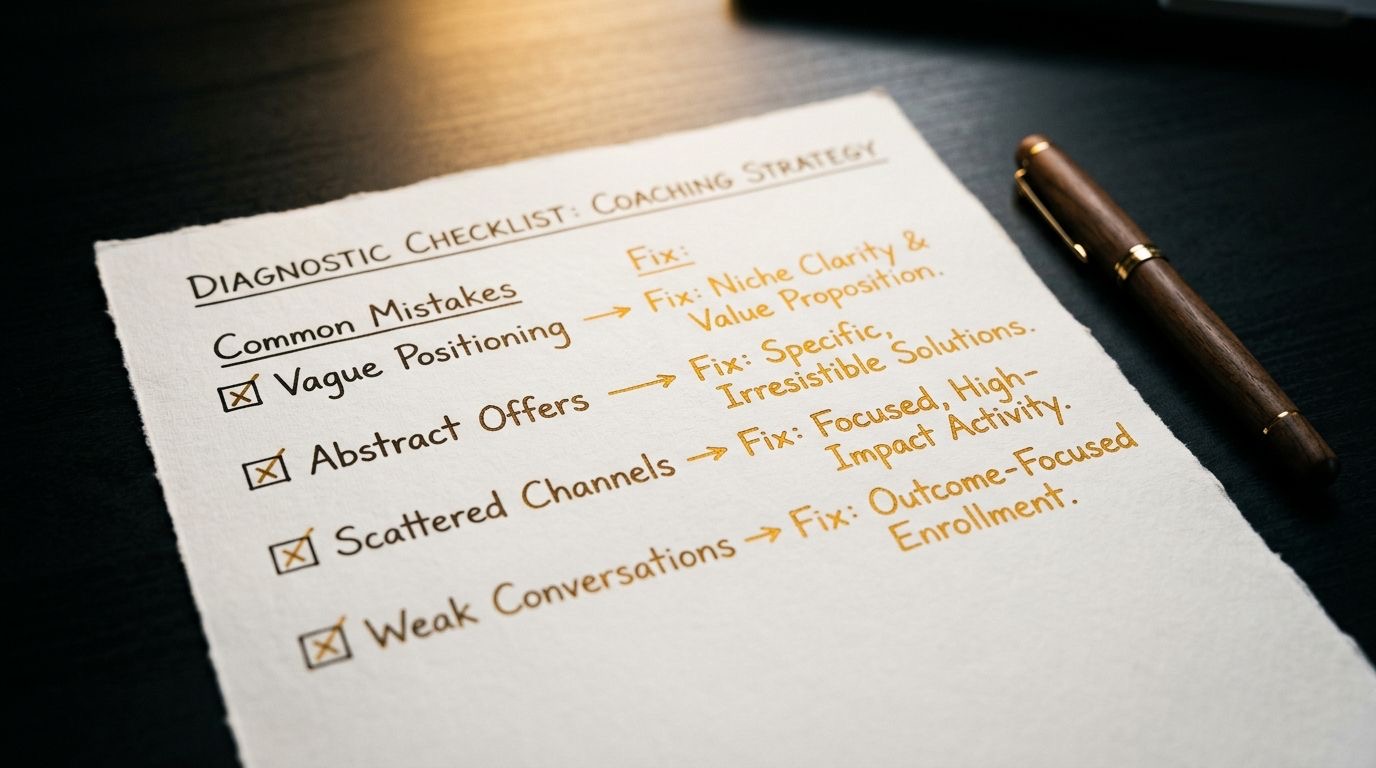
Being good at coaching is not the same as being easy to hire.
That is a frustrating distinction for a new coach. You may be trained, sincere, thoughtful, and active. You may be posting, rewriting your bio, improving your website, and wondering whether another certification would make people take you more seriously.
Still, people do not quite understand what you do. Referrals come in vague. Discovery conversations drift. Someone says, “This sounds interesting,” but no clear next step follows.
The first conclusion is often personal: maybe you are not confident enough, experienced enough, or ready enough.
Sometimes skill needs work. Sometimes confidence needs work. But “I need clients” is not a diagnosis. It is a symptom. The real issue may be a vague market, an abstract offer, coach-centered messaging, scattered visibility, copied positioning, no conversation routine, or unclear value.
This guide is not a shame list. It is a diagnostic for finding the business habit that is making your coaching harder to understand, remember, refer, or hire.
Why new coaches fix the wrong things first
When a coaching business feels quiet, the visible fixes are tempting.
Redesign the website. Change the logo. Post more. Download a content calendar. Rewrite the bio again. Get another certification. Consider ads. Lower the price before anyone has clearly objected.
Some of those moves can be useful in the right place. A clear website matters. Skill matters. Content can help. Pricing deserves thought.
But none of them can carry an unclear business foundation.
If people cannot understand who you help, what problem you help with, why it matters now, where to find you consistently, and what next step to take, more activity often creates more noise. You can stay busy and still learn very little.
That is the tradeoff: scattered work can feel productive because it takes energy, but energy is not the same as signal. The better question is not, “What can I do today so I feel less stuck?” The better question is, “What is making this offer harder to buy?”
Start there.
Mistake one: staying too general
The classic new coach sentence sounds like this:
I help people find more confidence, clarity, and purpose.
It sounds generous. It sounds inclusive. It also gives the market almost nothing to hold onto.
“People” could mean anyone. Confidence could mean leadership confidence, dating confidence, career confidence, parenting confidence, public speaking confidence, or the confidence to make a hard decision. Clarity could mean choosing a niche, leaving a job, planning a week, ending a relationship, or deciding what to say in a meeting.
The coach feels like they are keeping doors open. The buyer experiences fog.
This usually comes from a reasonable fear. New coaches do not want to exclude people they could help. They do not want to choose the wrong niche. They worry that naming one audience will trap them too early.
But specificity is not a lifetime sentence. It is a working entrance into the market.
Use the referral test:
Could someone hear your offer sentence once and accurately repeat it to a friend who might need it?
Compare these two versions:
I help people feel more confident and find clarity.
I help first-time managers lead their first team without second-guessing every decision.
The second version is not perfect, but it gives people a handle. It names a person, a situation, and a recognizable problem.
For the next 30 days, run a specificity test. Choose one type of person, one concrete situation, and one practical reason they would seek help now.
For example:
- First-time managers who are overwhelmed in their first 90 days.
- Mid-career professionals who look successful on paper but feel stuck in their current role.
- Independent consultants who need to lead better client conversations without overexplaining.
- New founders who are making too many decisions alone and need a clearer operating rhythm.
You are not deciding your identity forever. You are creating a clearer market signal long enough to learn.
Related guide: [The mistakes that keep new coaches invisible](#internal-link-suggestions) should deepen this point, because vague positioning is one of the fastest ways to become hard to notice and harder to refer.
Mistake two: selling an abstract transformation
A coach can choose a specific audience and still make the offer hard to buy.
For example:
I help first-time managers step into their authentic leadership potential.
There may be something real inside that sentence. The problem is that the buyer has to translate it.
Coaches often speak in transformation language. Buyers usually live in situation language.
Transformation language includes words like purpose, alignment, empowerment, confidence, potential, breakthrough, inner blocks, and “step into your power.” Some of those words may describe real experiences inside coaching. Before someone buys, though, they are usually asking a more practical question: “Is this for the problem I am dealing with?”
They are living in concrete situations:
- I avoid hard conversations with my team.
- I want to leave my job, but I do not know what comes next.
- I look successful on paper, but I am exhausted by how I am working.
- I have too many priorities and no clear decision process.
- I keep saying yes to clients and then resenting the workload.
That is buyer language.
Compare these examples:
I help people build confidence and step into their power.
I help new managers stop avoiding hard conversations so they can lead their team with more clarity.
And:
I help women reconnect with their purpose.
I help mid-career professionals who feel stuck in a role that looks good on paper clarify their next move without blowing up their whole life.
The concrete versions are easier to understand. They also set cleaner expectations. When an offer is built around a phrase like “highest potential,” it can become so large that neither coach nor client knows what is actually being promised. When the offer is built around a recognizable situation, the work has a clearer boundary.
That is not just better marketing. It is more responsible.
To fix this, take every transformation word in your offer and translate it into one of five things:
- A visible situation.
- A decision the buyer is facing.
- A behavior they want to change.
- A conversation they are avoiding.
- A problem they already recognize.
If your offer says “clarity,” ask, “Clarity about what?” If it says “confidence,” ask, “Confidence to do what?” If it says “alignment,” ask, “What decision, behavior, or tradeoff would show that in real life?”
Related guide: [Why vague transformation language makes coaching harder to buy](#internal-link-suggestions) should go deeper into translating coaching language into buyer language.
Mistake three: making the message about the coach too soon
Your story can matter. Your training can matter. Your method can matter. Your values can matter.
Usually, they should not come first.
A prospect’s first question is not, “What is this coach’s entire story?” It is, “Does this person understand the problem I am dealing with?”
Coach-centered messaging often starts with the coach’s story, passion, framework, certification, belief system, or reason for becoming a coach. Those things may build trust later. But if the first paragraph is all about the coach, the buyer may leave before they find themselves in the message.
Coach-centered:
After my own burnout, I discovered my calling and created a powerful framework to help people reconnect with their truth.
Buyer-centered:
If you look successful on paper but feel exhausted and unsure how long you can keep working this way, this work is designed for that crossroads.
The second version gives the buyer a mirror. It does not erase the coach’s story. It simply puts recognition first.
Audit your main surfaces:
- Homepage opening.
- LinkedIn headline.
- Social bio.
- Networking introduction.
- Podcast guest intro.
- Sales page opening.
- Email signature line.
Count how long it takes before the buyer’s situation appears.
If the first few lines are mostly “I believe,” “I am passionate about,” “my story,” or “my method,” rewrite the opening around the buyer’s recognizable situation. Then use your story, method, training, or values as supporting context.
Recognition first. Persuasion second.
Mistake four: copying language from coaches who are already visible
Copying another coach can feel efficient. Their website looks polished. Their offer sounds confident. Their posts get attention.
So a new coach borrows the niche language, the offer name, the promise structure, the bio, or the sales page rhythm.
The result may sound professional and still not be trustworthy.
Borrowed language often misses your actual audience, your actual skill and scope, your delivery method, and the real words your market uses. That is why copied positioning can feel hollow. It may look like a shortcut, but it prevents the most important work: learning how your market talks about the problem and how your offer responsibly fits it.
There is nothing wrong with studying structure. You can look at how another coach organizes a page, explains a container, names a section, or makes a clean invitation. But structure is not substance.
Use other coaches for learning, not language theft.
Then rewrite around your own business:
- Who do you actually help right now?
- What problem are you prepared to support?
- What is inside your coaching container?
- What can you responsibly promise?
- What should you not imply?
- What words have real prospects used when describing this problem?
Your offer does not need to sound like everyone else’s. It needs to sound clear, grounded, and connected to work you can actually deliver.
Related guide: [Why copying another coach’s offer weakens trust](#internal-link-suggestions) should expand this into a fuller trust and positioning problem.
Mistake five: having no primary acquisition channel
This is the scattered visibility pattern:
Two weeks on Instagram. Three LinkedIn posts. One newsletter draft. A networking event. A webinar idea. A podcast pitch. A thought about ads. Then the conclusion: nothing is working.
Maybe nothing is working. More often, nothing has been tested long enough to create clean feedback.
Random channel behavior creates random data.
If you switch channels every few days, you cannot tell whether the issue is the audience, the message, the offer, the format, the consistency, or the channel itself. You only know you are tired.
New coaches often scatter because they are trying to find the right place. They hear one person recommend LinkedIn, another recommend Instagram, another recommend newsletters, another recommend local networking.
The better first move is to choose one primary channel for the next 30 days and define what consistent market contact means there.
For example, leadership, career, founder, consultant, and professional coaching may fit LinkedIn, alumni networks, professional communities, or industry groups. Local coaching may fit local networking, associations, workshops, partner relationships, or community events. Wellness-adjacent or creator-based coaching may fit Instagram, newsletters, or community platforms, while still using clear non-clinical language and responsible boundaries.
The point is fit and focus.
If the answer is “everywhere,” the practical answer is probably “nowhere consistently.”
Choose one primary channel. Stay with it long enough to learn. Track the message, the conversations, and the objections. A quiet week is not automatically failure. It may be feedback.
Mistake six: posting and waiting
Posting is not a pipeline.
Content can support a pipeline. It can make your thinking visible. It can build trust. It can help people understand your point of view. It can start conversations.
But content does not automatically create client conversations just because it exists.
The posting-and-waiting pattern looks like this: you publish useful content, a few people like it, maybe someone comments, and then you wait for someone to ask about coaching. At the end of the week, there were posts, but no real conversations with relevant people.
This pattern is common because posting creates distance from rejection. If a post does not perform, you can blame the algorithm, timing, or format. Sometimes those things matter. But a coaching business, especially early on, needs more than passive visibility.
It needs respectful conversations.
A simple conversation routine can include identifying relevant people or communities, responding thoughtfully when people engage, starting contextual conversations based on a real connection point, asking permission before shifting into a coaching-related invitation, following up when there is a real next step, and tracking what happens.
This does not mean spam. It does not mean cold pressure. It does not mean treating people like targets. It means your week includes real market contact, not only public broadcasting.
For example, if you write a LinkedIn post about first-time managers avoiding hard conversations, do not only count likes. Notice who engaged. Reply with substance. If someone comments with a real situation, continue the conversation. If it becomes relevant, you might say:
It sounds like this is showing up in your new role in a practical way. If useful, I can send you a few questions I use with first-time managers to sort out what conversation needs to happen first.
That is a clean bridge. It is relevant, specific, and low pressure.
Related guide: [Why posting more is not a client acquisition plan](#internal-link-suggestions) should go deeper into the difference between visibility and pipeline.
Mistake seven: lowering the price before fixing clarity
Price may need review. A coach can be overpriced for a market, under-explained for a buyer, or unclear about the container. Pricing is part of the business.
But discounting is often the wrong first diagnosis.
If prospects are not moving forward, the problem may be price. It may also be unclear value, weak fit, vague problem language, low trust, poor timing, or no clean next step.
Discounting does not fix a confusing offer.
Before you lower the price, check whether a serious prospect can answer these questions:
- What problem does this coaching help with?
- Why does it matter now?
- Who is this offer designed for?
- What does the coaching container include?
- What can be responsibly expected without guarantees?
- What is the next step if they want to explore fit?
If those answers are unclear, a lower price may only make the same confusion cheaper.
This is not financial advice, and it is not a rule that discounts are always wrong. There are valid reasons to offer a beta price, a founding rate, a scholarship, a limited-scope package, or a different container.
The warning is narrower: do not use discounting to avoid the harder work of making the offer understandable.
Related guide: [Why discounts do not fix an unclear coaching offer](#internal-link-suggestions) should expand the pricing caution without turning it into a rigid rule.
Example: diagnose a vague networking introduction
Here is a common networking introduction:
Hi, I am a coach. I help people reconnect with themselves, overcome inner blocks, and live with more confidence, clarity, and purpose.
This sounds sincere. It is also hard to refer.
The diagnosis is straightforward. “People” could mean anyone. “Reconnect,” “inner blocks,” “confidence,” “clarity,” and “purpose” are hard to evaluate before buying. The listener has to figure out what situation this applies to, and a referral partner does not know who to send.
Now compare it with this:
I help newly promoted managers who feel overwhelmed in their first 90 days build clearer priorities, communicate better with their team, and stop second-guessing every decision.
This version works harder. It names the person, the situation, and the problem. It gives referral partners a handle. It also avoids an exaggerated promise. It does not say the manager will become a perfect leader, eliminate all stress, or transform their entire life. It gives a concrete reason to continue the conversation.
That is the standard: clear enough to recognize, responsible enough to trust.
The self-score diagnostic
Use this as a quick diagnostic, not a verdict on your ability.
Score each item from 1 to 5. A 1 means unclear, inconsistent, or mostly absent. A 5 means clear, active, and easy to observe.
- Can a stranger understand exactly who you help?
- Can a prospect understand the concrete problem your offer addresses?
- Does your message start with the buyer’s situation rather than your story?
- Are your words genuinely yours, grounded in your real market and delivery?
- Do you have one primary acquisition channel for the next 30 days?
- Do you have a routine for creating or continuing relevant conversations?
- Are you checking clarity before changing price?
If one area scores a 1 or 2, treat it as the next piece of work.
If several areas score low, do not try to fix everything at once. Start with the earliest weak point in the chain. Usually, that means market clarity or offer clarity before channel changes, content volume, or price changes.
More outreach with a vague message often creates more confusing data. More content for an undefined reader creates more generic content. More discounting on an unclear offer creates more uncertainty around value.
The score is there to help you choose the next useful move.
What to fix first
Use this order when the business feels noisy:
- Fix who the offer is for.
- Fix the concrete problem or situation.
- Rewrite the first message around the buyer.
- Make sure the language is yours, not borrowed from a coach with a different business.
- Choose one primary acquisition channel for 30 days.
- Add a respectful conversation routine.
- Review price only after fit, value, container, and next step are understandable.
This sequence matters because every later step depends on the earlier ones.
If the audience is vague, content becomes generic. If the offer is abstract, conversations become harder. If the message starts with the coach too soon, buyers may not recognize themselves. If the channel keeps changing, feedback stays messy. If there is no conversation routine, posting becomes passive. If price changes before clarity, you may misread the real objection.
The next useful move is usually one repair, not a total brand rebuild.
Pick the lowest early-chain score and work on that first.
Where this fits in the coaching business
This guide is the parent article for the “what new coaches should avoid” cluster. Each mistake deserves deeper treatment because the fix is not always a quick copy edit.
Use the related guides this way:
- If your issue is visibility, read [The mistakes that keep new coaches invisible](#internal-link-suggestions).
- If your offer is full of transformation language, read [Why vague transformation language makes coaching harder to buy](#internal-link-suggestions).
- If your week is mostly publishing and waiting, read [Why posting more is not a client acquisition plan](#internal-link-suggestions).
- If your offer sounds like someone else’s website, read [Why copying another coach’s offer weakens trust](#internal-link-suggestions).
- If you are tempted to lower the price first, read [Why discounts do not fix an unclear coaching offer](#internal-link-suggestions).
For broader business structure, connect this article to [The coaching offer clarity checklist](#internal-link-suggestions), [The client acquisition checklist for new coaches](#internal-link-suggestions), [The respectful sales conversation checklist for new coaches](#internal-link-suggestions), and [The professional coaching boundaries checklist](#internal-link-suggestions) once those pillar articles are available.
The next useful move
The goal is not to become louder, cheaper, or more aggressive. The goal is to become easier to understand, easier to trust, and easier to refer.
Choose one weak point from the diagnostic. Spend your next work session improving that item before changing platforms, posting more, redesigning your website, or lowering your price.
If the weak point is audience clarity, write three possible “I help” sentences and test them with real people. If the weak point is abstract offer language, translate every transformation word into a concrete situation. If the weak point is posting and waiting, add a small, respectful conversation routine to your week. If the weak point is price panic, check whether the offer is clear enough before you change the number.
CoachGuido’s broader client acquisition system is built around the same sequence: clarify the offer, create respectful conversations, follow up without pressure, and build a repeatable acquisition loop. No hype. No fake urgency. Just the business side of coaching made clearer.



0 comments
No comments yet.